
Weekend Update #289

Thank you for your continued support and engagement. Each week, we're sharing what companies we're researching and the what, the who and the how that we think makes the companies interesting and unique. This roundup is brought to you weekly by a group of interns, creative minds, artists and investors who believe that through best in class investing along with the democratization of financial education we can do great things together. Enjoy, Explore and Share.

U.S. equities rose this week following Nvidia earnings, PCE inflation data, the Treasury’s new debt buyback plan, and Federal Reserve Chairman Kevin Warsh’s address at the Jackson Hole summit. Nvidia delivered a substantial signal of strength for the AI buildout on its Wednesday earnings call, projecting 70% sales growth next year compared to the 45% average analyst estimate. NVDA shares rose 8.7% on Thursday following the earnings results and call, the most since April 2025, and helped reinstill confidence in stocks linked to the AI buildout. While talks between the U.S. and Iran are at a standstill, PCE data for July was slightly hotter-than-expected and placed some emphasis back on the risk of an energy shock to price stability. Treasury Secretary Scott Bessent announced a rare increase in buyback operations on the long end in an attempt to restore equilibrium levels to the bond market. However, the move was seen as a short-term attempt to directly intervene in a bond market that is signaling further rate hikes or fiscal policy tightening will be necessary. Against this backdrop, Fed Chair Kevin Warsh took the stage on Friday at Jackson Hole.
Fed Chair Warsh delivered one of the longest Jackson Hole addresses, blasting the Fed’s old forward guidance policies and committing to a hawkish stance in restoring inflation to the 2% target. He cited that 49% of components within PCE showed annualized price increases above 3%, well above normal levels, and that the FOMC must be confident that PCE is moving toward target “clearly and at sufficient speed”. The hawkish commentary helped restore a sense of Fed credibility that had come into question with Warsh’s shift away from certain FOMC traditions and toward innovations in the Federal Reserve’s framework. Chair Warsh also characterized the AI buildout as an inflection point in history that is delivering elevated CapEx investment and earnings with full employment, a backdrop that shows if a rate hike comes, it will be a hike into strength rather than weakness. Following the hawkish Jackson Hole speech, the market-implied probability of a rate hike at the September FOMC meeting rose to 58.3% on Friday from 35.8% on Thursday. The market now expects the Federal Reserve to hike at least once before year-end 2026.
In economic data for the week, the Conference Board’s August Consumer Confidence report showed a weaker-than-expected reading, weighed down by consumers’ more pessimistic expectations for business conditions, employment, and incomes in the future. The Personal Consumption Expenditures Price Index for July rose 0.2% MoM and 3.7% YoY, above the 0.1% and 3.6% consensus expectations, respectively. Excluding food and energy, core PCE was in line with expectations, rising 0.2% MoM and 3.3% YoY. At the margin, the slightly hotter-than-expected headline reading keeps inflation in focus as a risk, especially with uncertainty around reopening the Strait of Hormuz. The report showed disposable income rose 0.4% and the savings rate rose to 3.0%, a four-month high, so there were indications of consumer stability within the report. Initial Jobless Claims for the week ended August 22 were 203,000, compared with the 208,000 estimate, revealing a stable employment picture. The University of Michigan’s Consumer Sentiment final report for August confirmed that sentiment fell in August, driven by a 10% drop in expected year-ahead business conditions and a 13% drop for the 5-year outlook, along with broad expectations for gasoline prices to continue to rise in the year ahead.
In company-specific news, Nvidia’s Q2 2027 earnings results were the highlight of the week, beating significantly on revenue and earnings expectations, driven by stepped-up hyperscale data center sales. The year-ahead guidance of 70% revenue growth helped investors to gain confidence in the durability of demand in the AI buildout and led to NVDA shares’ 8.7% daily gain. Salesforce also had a strong 22.6% gain after earnings, rising the most in 6 years, after the company’s revenue outlook exceeded expectations and it announced a deepened partnership with Anthropic. CrowdStrike shares also rose 20.5% following earnings results as cybersecurity demand outpaced expectations as AI models become more advanced and corporations need to prepare for breaches. On the consumer side, Dick’s Sporting Goods shares fell 30.7% after earnings results underwhelmed expectations and signaled a lasting slowdown in consumer demand for the rest of the year. Not all consumer companies faced similar pressures though, with Abercrombie & Fitch rising 35.7% following earnings as results surpassed expectations. PayPal shares came under pressure on Friday as Advent and Stripe abandoned a potential $50 billion acquisition of the company. Meta Platforms made headlines as the company settled a lawsuit over the platform's addictiveness for children, brought on by 29 state AGs. Meta will pay up to $18 billion to states involved, and the company has launched campaigns pressuring TikTok and YouTube to implement similar safety measures agreed to as part of the settlement. Next week, investors will look forward to the August ISM Manufacturing and Nonfarm Payrolls reports as key data points leading up to the FOMC’s September 16 rate decision.
Friday’s Close (Weekly Performance)
S&P 500 7,711.76 (+0.49%)
Nasdaq 26,402.42 (+0.85%)
Dow Jones 53,559.99 (+0.53%)
Thank you Blue Room Senior Analyst JARED FENLEY
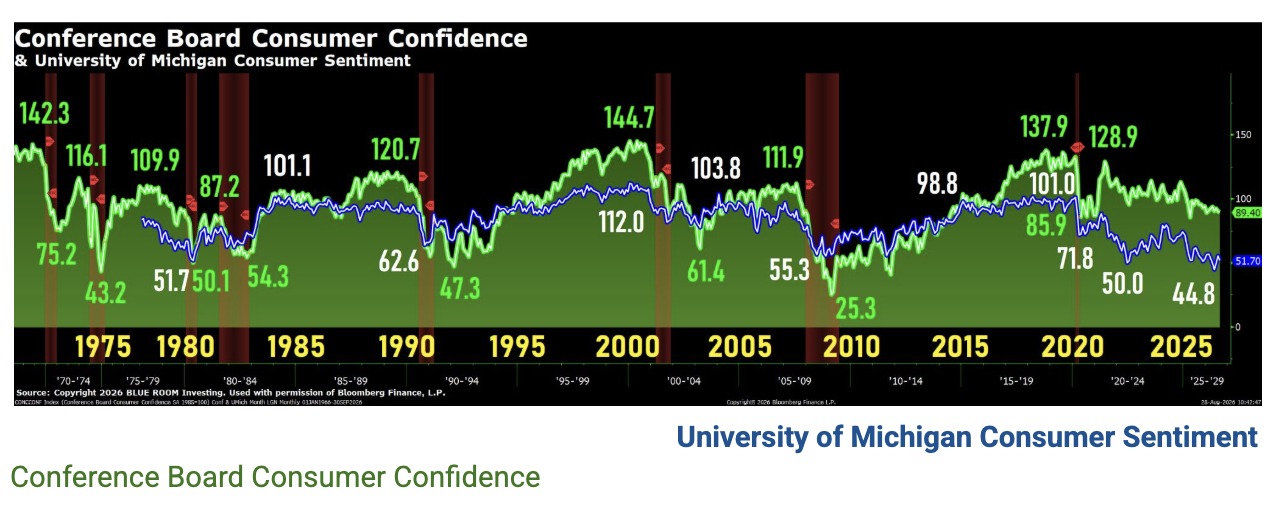
Consumer sentiment confirmed its early-month reading, falling about 6% from last month to 51.7 and landing about 11% below a year ago amid continued worries that inflation will remain elevated for the foreseeable future.
Sentiment declines in August were seen for all political groups and were particularly acute among Republicans. Moreover, groups who are typically less-equipped to absorb increases in cost of living also exhibited stronger decreases in sentiment, including older consumers, lower- and middle-income consumers, and those with no stock holdings.
With ongoing policy uncertainty including the Iran conflict, consumers anticipate further increases in gasoline prices both in the short and long run.
In addition to the pocketbook issues that have been central to consumers’ views of the economy, they are increasingly worried that prospects elsewhere in the economy could be weakening. Expected year-ahead business conditions fell back 10%, along with a 13% drop for the five-year horizon. Any re-escalation of trade tensions will likely exacerbate these trends.
This release covers interviews completed between July 28 and August 24.




10% OF ALL BLUE ROOM REVENUES GO DIRECTLY TO FUND OUR NON PROFIT TOGETHERISM.
WE CAN ACCOMPLISH ANYTHING TOGETHER.
These materials do not purport to be all-inclusive or to contain all the information that a prospective investor may desire in considering an investment. These materials are intended merely for preliminary discussion only and may not be relied upon for making any investment decision. Any discussion or information contained in this presentation does not serve as a receipt of, or as a substitute for, personalized investment advice from Blueroom or your advisor.
This publication does not constitute an offer to sell or a solicitation to buy any securities in any fund, market sector, strategy or any other product. Investing is speculative and involves substantial risks (including, the risk of loss of the investor’s entire investment). Past performance is not indicative of future results, and there can be no assurance that the future performance of any specific investment, investment strategy, or product will be profitable.
For more information about us and our general disclosures contact us directly.