
Weekend Update #288

Thank you for your continued support and engagement. Each week, we're sharing what companies we're researching and the what, the who and the how that we think makes the companies interesting and unique. This roundup is brought to you weekly by a group of interns, creative minds, artists and investors who believe that through best in class investing along with the democratization of financial education we can do great things together. Enjoy, Explore and Share.

Equities capped a record-setting week on a softer note, with the S&P 500 slipping 0.2% Friday to 7,785 but still posting a third straight weekly gain, up 0.4%. The Nasdaq Composite eked out a 0.1% gain for the week, finishing Friday at 26,729, while the Dow lagged, falling 107 points on the day to 53,732 and ending the week down 0.6%. The high-water mark came Thursday, when the S&P hit an intraday record of 7,816.70 before logging its 27th record close of the year at 7,798.99. Back-to-back inflation reports helped push concerns around a September rate hike further into the background. Friday’s pullback came as weaker retail sales and a sharp drop in consumer sentiment cooled a market that had risen for three straight sessions. Geopolitics also stayed in focus throughout the week: President Trump said the U.S. has “total control over the Hormuz Strait,” Treasury Secretary Scott Bessent pointed to unprecedented economic isolation measures against Iran, and oil remained firm with Brent near $87 a barrel.
July core CPI rose 0.2% month over month and 2.5% year over year, while headline CPI increased just 0.1% on the month and 3.4% from a year earlier, with both measures easing from June. Producer prices also came in softer than expected, with PPI up 4.7% from July 2025 versus 5.5% in June and core PPI running at 4.2% year over year, another sign that the war-driven energy shock is beginning to fade from the pipeline. The consumer data was less encouraging. Retail sales fell 0.6% in July, the steepest decline since May 2025, with five of 13 categories lower and nonstore retailers down 2.2%. The University of Michigan sentiment index dropped to 51.0 in August from 55.2 in July, while one-year inflation expectations rose to 4.3% and long-run expectations remained elevated at 3.3%. Initial jobless claims increased by 9,000 to 209,000 for the week ended Aug. 8, while continuing claims fell by 22,000 to 1.777 million. Taken together, the data took some pressure off the Fed, with the probability of a September hike falling to 31.8% from 44.0% a week earlier. Still, weaker spending alongside inflation expectations above 4% leaves policymakers with a less-than-clean picture.
Corporate news was dominated by AI infrastructure and the financing needed to support it. OpenAI is tracking toward an annualized revenue run rate above $40 billion ahead of its IPO, roughly double its pace at the end of 2025, driven by coding software, subscriptions and a nascent advertising business. Anthropic was active on two fronts, signing a $9.1 billion cloud agreement with Riot Platforms for 191 megawatts at its Rockdale, Texas campus while also entering talks to acquire world-model startup Decart for roughly $6 billion. CoreWeave surged after guiding third-quarter revenue to $3.45–$3.6 billion and raising full-year revenue guidance to $12.4–$13.2 billion against a $104 billion backlog. The financing side of the AI buildout was just as notable: Intel raised an upsized $20 billion at $95 per share after receiving more than $100 billion of orders, while AMD priced a record $4.75 billion bond offering. Elsewhere, TSMC reported a 45% increase in July revenue, Meta released Muse Glimmer, a 30-billion-parameter model designed to run locally, and Reddit will replace AvalonBay in the S&P 500 before Tuesday’s open.
The week ahead is lighter on macro but heavy on consumer read-throughs. Monday brings the Empire State manufacturing index and NAHB housing market index, followed Tuesday by housing starts, industrial production and pending home sales. Wednesday’s FOMC minutes should provide the first detailed look at the dissents behind July’s decision to hold rates steady, while Thursday brings jobless claims, the Philadelphia Fed index and leading indicators. Retail earnings will likely be the bigger focus, with Home Depot reporting Tuesday; Target, Lowe’s, TJX and Analog Devices on Wednesday; and Walmart, Ross Stores and Deere on Thursday. Those results should help show whether July’s spending weakness was a one-month soft patch or the start of a broader consumer slowdown. Nvidia’s Aug. 26 report remains the next major catalyst for the AI complex. Hormuz also remains the key geopolitical swing factor: a negotiated reopening could quickly take some of the premium out of oil, but with Washington and Tehran both hardening their positions, a near-term resolution still looks uncertain.
Friday's Close (Weekly Performance)
S&P 500 7,785.76 +0.36%
Nasdaq 26,729.16 +0.14%
Dow Jones 53,732.41 -0.56%
Thank you Blue Room Senior Analyst NICK PEART
Michael Intrator
Co-founder, President, CEO & Chairman
Q2 2026 was an exceptional quarter for CoreWeave. We outperformed our plan across the board with the operating leverage we have been building beginning to show up clearly in our results. Extraordinary execution across the organization, drove record financial performance, rapid capacity growth, broadening customer demand and continued platform innovation. We generated record revenue of $2.6 billion, up 112% year–over–year. Increased revenue backlog to $104 billion while driving rapidly expanding enterprise adoption. This figure does not include the over $25 billion of net new customer commitments added in the early weeks of Q3 2026.
We continue to execute on our power strategy, reaching 1.5 gigawatts of active power, adding nearly 500 megawatts, more than any quarter in our history and more than tripling year–over–year. We remain firmly on track to reach at least 8 gigawatts by 2030.
We grew adjusted operating income to $128 million, with margins expanding meaningfully as our scale increasingly translates into operating leverage, and we continue to broaden our technology stack, delivering 7 new AI platform capabilities, and achieving multiple industry–first milestones that enable customers to build, deploy and operate AI faster and at greater scale.
Our incredible progress is a testament to the entire organization, and the business is only getting stronger. In Q2 2026, the customer contracts we signed came with contribution margins we expect to be 5 to 10 percentage points above those added in recent quarters. This is more than a collection of milestones. It is evidence that the AI market is developing in line with the convictions on which we built CoreWeave.
We believe that the AI era is here and will ultimately touch every part of the global economy, that every organization is being transformed, creating an opportunity to reinvent established markets and create entirely new ones that the future will be led by the pioneers who seize that opportunity, both AI–native companies at the frontier and change makers inside established enterprises. That learning and iterating at light speed are now table stakes for AI leadership. And we believe those pioneers need a new kind of platform to unleash AI's potential at scale. These beliefs are the operating assumptions that drive our strategy. They guide our product road map, our capital allocation, our partnerships and ultimately, how we serve our customers.
Today, I want to discuss how our vision is translating into 4 areas:
● One, broadening demand and customer adoption;
● Two, the continuous AI development tools we provide on our platform;
● Three, the performance and economics enabled by our AI native architecture; and
● Four, the power and supply chain foundation that will support years of growth.
AI is transforming every organization. The debate around future demand for AI cloud infrastructure will likely continue. But what we know with certainty is informed by our customers' actions. Demand continues to intensify as the market broadens across sectors, geographies, workloads and generations of GPU architecture.
AI is no longer confined to frontier model labs. It is becoming embedded in software, industrial systems, financial markets, enterprise workflows and national security missions. We see that breadth in our backlog, in the new commitments we have signed and in the utilization and pricing environment across our platform. Pricing and margins for our Blackwell and Vera Rubin SKUs are setting new highs, while pricing for prior generation SKUs is at or above where it was years ago. Our near–term capacity remains effectively sold out. That is translating into signed commitments on increasingly favorable terms from a broadening set of customers and is positioning CoreWeave to gain market share for years to come.

2026 08 13 BLUE ROOM: Financial Engineering
BLUE ROOM Investment Team Bullpen
Thursday, August 13, 2026
10:30 AM
Financial Engineering Analysis: AI Factory Data Centers by Minyoung Sohn
Disclosure:
This video is for informational purposes only and does not constitute investment advice.
Chris Rogers
Chief Executive Officer & Board Chair
Thanks, Rebecca. Good afternoon, everyone, and thanks for joining us. Our business is performing incredibly well. We've meaningfully accelerated our growth over the past three quarters, including a strong Q2 performance, where we grew GTV 14% year-over-year. We also increased total revenue by 14%, driven by a stronger-than-expected advertising and other revenue performance, which grew 16% and again outpaced GTV growth. At the same time, we expanded adjusted EBITDA and operating cash flow year-over-year, reflecting our continued focus on driving profitability while reinvesting for growth.
These results reflect broad-based momentum across our business. We're continuing to improve the customer experience on our leading online grocery marketplace, accelerate adoption of our enterprise technologies with retailers, and expand the breadth and depth of our advertising ecosystem.
That momentum is showing up in our customer base. Over the past three quarters, we've activated net-new customers at our fastest year-over-year growth rates since 2022, helping drive strong monthly customer growth, while we've continued to deepen customer engagement.
With that, let me walk you through how we're executing across our growth engines. Starting with marketplace. Our fundamentals remain strong because we're relentlessly focused on delivering the best end-to-end grocery experience. One of our biggest advantages is our data. We completed more than 1.6 billion lifetime orders, built a catalog of over 2 billion products, and operate at a scale where our shopper network visits large-format stores an average of more than 15 times a day.
Every day, we generate more than 10 million inventory signals that help us understand what's actually available on-store shelves in real time. Every order placed, item picked, and substitution completed makes that understanding even stronger. That gives us a structural advantage that's incredibly difficult to replicate, and it allows us to build better grocery experiences with every order.
We're using that advantage to continuously improve order quality, which we know is one of the most important drivers of repeat customer behavior. In Q2, we improved both our found rate and perfect order fill rate year-over-year for the 16th consecutive quarter. We're building on that momentum with new capabilities that make shopping more personalized and orders even more accurate.
This quarter, we began testing personalized health tags and nutrition scores, which help customers discover products that better match their dietary preferences. Customers will start seeing simple indicators that identify products aligned with their nutritional preferences and make it easier to compare options while they shop.
We're also making replacements more personalized with a new model that better incorporates customers' dietary preferences. So if a customer's preferred product is out-of-stock, we're much more likely to recommend a relevant replacement such as gluten-free, low sugar, or allergen-free.
Beyond improving today's customer experience, we're continuing to invest in what we believe is one of Instacart's biggest advantages, inventory intelligence. In July, we acquired Arpalus, whose computer vision technology turns a quick video scan into a highly accurate view of what's actually on the shelf. By combining Arpalus' technology with our operating scale and network of approximately 600,000 shoppers, we expect to drive additional fulfillment efficiency, enable more relevant AI-powered shopping experiences, and further strengthen our inventory intelligence.
Our data advantage is helping us build the gold standard in agentic grocery shopping. Our AI assistant doesn't simply recommend recipes or generic product pairings, it understands the customers' preferences, recent purchase history, what's actually available at nearby stores, and current promotions. It then turns those insights into an order that's ready to be placed and delivered in as fast as an hour. Customers are already using our AI system to quickly restock their essentials, find deals and discounts, order ingredients from recipe suggestions, discover new products, and plan meals.
Orders placed with our AI system are on average larger than our typical basket. That's especially notable given our industry-leading average order value of $115. We're excited to build on this momentum and launch our AI system across our marketplace in North America over the next several weeks.
We remain focused on affordability, which we know is one of our biggest opportunities to accelerate online grocery adoption. Retailers that offered no markups on item prices continue to drive faster growth and stronger customer retention. Instacart already has more retailers offering online grocery delivery with no markups than any other third-party marketplace in North America, and we're continuing to extend that advantage. Grocery Outlet is eliminating markups nationwide across our marketplace, alongside regional favorites like Strack & Van Til and Super King Markets. New partners, including Ace Hardware, Calgary Co-op, Tractor Supply Company, and World Market are also launching with no markups right out of the gate.

2026 08 07 BLUE ROOM: CART
BLUE ROOM Investment Team Bullpen
Friday, August 7, 2026
10:30 AM MDT
Model update:
CART: Instacart Q2 2026 Earnings Review
by Jared Fenley
Disclosure:
This video is for informational purposes only and does not constitute investment advice.
Joe Creed
Chairman & Chief Executive Officer
All right. Thanks, Alex, and good morning, everyone. Thanks for joining us today. In the second quarter, sales and revenues were better than expected at $20.5 billion, up 24% versus the prior year, driven by strong end market demand in all three of our primary segments. This is the first time in company history that we've generated over $20 billion of sales and revenues in a single quarter. This milestone underscores both the essential work our customers do every day and the dedication of Caterpillar employees worldwide to solving our customers' toughest challenges.
We delivered adjusted profit per share of $8.17, an increase of 73% versus last year. Our backlog grew sequentially by $9 billion to $72 billion. This is an increase of approximately $35 billion, or 92% compared to the second quarter last year. All three primary segments contributed to both the year-over-year and sequential backlog growth. Strong order rates and a growing backlog reflect broadening momentum across our business. In the quarter, we generated robust MP&E free cash flow of $5.1 billion and deployed $2.2 billion to shareholders through share repurchases and dividends.
Now, I'll discuss second quarter results in more detail. As I mentioned, sales and revenues were $20.5 billion, and the increase versus prior year was primarily driven by strong growth in sales volume from higher sales to users in all three primary segments and favorable price realization.
Second quarter sales and revenues were better than expected due to strong sales volume growth in Construction Industries and Resource Industries, while Power & Energy was broadly in line with our expectations. Adjusted operating profit margin was 21.9%. Second quarter adjusted operating profit margin was better than we anticipated, primarily due to IEEPA tariff recoveries of $392 million and lower than expected tariff costs.
The margin benefit from better than expected sales volume was mostly offset by higher SG&A and R&D expense. For tariffs introduced since the beginning of 2025, excluding IEEPA recoveries, costs were about $400 million in the quarter. This was lower than the estimate we provided in April due to favorable adjustments to the computation of tariffs previously incurred. Kyle will explain in more detail in a moment, including the impact to each segment.
Now, I'll review second quarter retail statistics. Sales to users grew in all three of our primary segments. In Power & Energy, sales to users grew a robust 33%. Power generation grew 72% driven by very strong demand for large gensets and turbines used in data center applications. Sales to users in oil and gas increased 6% and were driven by reciprocating engines, turbines, and turbine related services sold into gas compression applications. Industrial sales to users were down due to a decline in engines sold in the marine application.
Construction Industries total sales to users grew for the sixth consecutive quarter up 22%. Increases in North America were better than we anticipated as the growth was driven by very strong rental fleet loading and equipment sold into non-residential and residential construction. Dealers' rental revenue continues to grow in North America requiring more investment in their equipment fleets. This quarter, rental loading was a positive contributor to sales to user growth as compared to second quarter last year when rental loading was a headwind.

2026 08 11 BLUE ROOM: CAT
BLUE ROOM Investment Team Bullpen
Tuesday, August 11, 2026
9:30 AM
CAT: Caterpillar Q2 2026 Earnings Review by Jared Fenley
Disclosure:
This video is for informational purposes only and does not constitute investment advice.
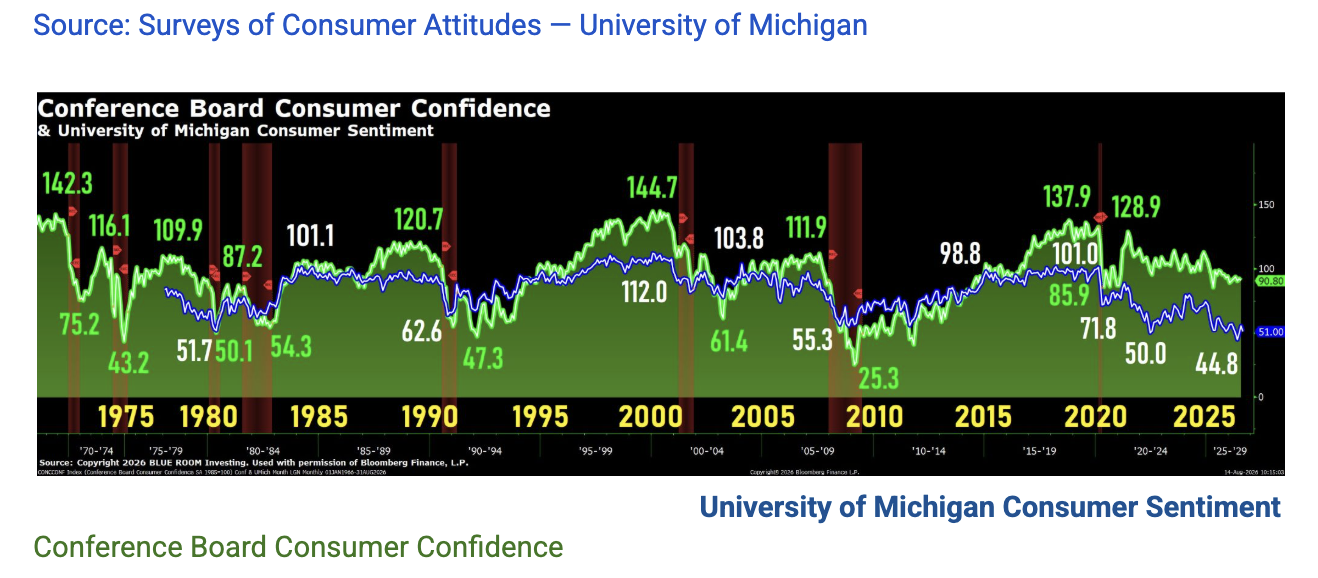
Consumer sentiment fell about 8% this August to 51.0, ending two consecutive months of improvement. While views of personal finances saw only minor declines, expected business conditions sank 11% for the short run and 17% for the long run.
Decreases in sentiment were seen across the political spectrum, with Republicans exhibiting the strongest month-to-month decline in August. Sentiment among Republicans is now 19% below readings just prior to the Iran conflict and the lowest since the 2024 election.
Although the early-month weakening in sentiment was pervasive across various demographic groups, notably large reductions were seen among older consumers, lower-income consumers, and those without a college degree. These groups are all particularly vulnerable to any erosion of purchasing power stemming from inflation.
Across all consumers, only 8% expect their income growth to exceed inflation in the year ahead, down from 18% in December 2024, a reflection of the belief that high prices will continue to be burdensome.
Interview questions related to labor markets and inflation help shed light on the relative economic risks perceived by consumers. As seen in the chart, real income expectations have broadly weakened over the past year and a half, with a growing majority expecting inflation to outstrip income gains (dark gray bars) and a very small minority expecting real income growth (orange bars), a pattern shared by all political groups. Overall, short-run expectations for nominal income growth as well as inflation both worsened this month.

2026 08 14 Economics Desk: Retail Sales and Consumer Sentiment
BLUE ROOM Investment Team Bullpen
Friday, August 14, 2026
9:30 AM
Economics Desk: Retail Sales and Consumer Sentiment by Jared Fenley
Disclosure:
This video is for informational purposes only and does not constitute investment advice.
2028 08 12 Economics Desk: CPI
BLUE ROOM Investment Team Bullpen
Wednesday, August 12, 2026
10:30 AM
Economics Desk: Consumer Price Index by Jared Fenley
Disclosure:
This video is for informational purposes only and does not constitute investment advice.
Abel Avellan — Founder, Chairman & Chief Executive Officer
Our execution in 2026 continued to reinforce what we have believed since we created AST SpaceMobile and invented the space-based cellular broadband market. That combining differentiated technology, deep partnerships with leading mobile network operators, and scaled vertical integration positions us to define the future of direct-to-device cellular broadband.
Our space-based direct-to-device network will be the first of its kind to leverage low-band and mid-band spectrum with broadband speeds and native cellular application, combining a feature set and technology stack that puts us in a category of one. From the beginning, we designed our network architecture alongside existing mobile network operators, not as a replacement for them. Rather than requiring operators to rebuild their infrastructure, our architecture and technology extends and complement their existing terrestrial network into space, allowing us to integrate efficiently while evolving alongside future 3GPP standards.
To put these concepts simply, we are building the direct-to-device network of the future today in partnership with -- not in competition with mobile network operators. This new layer of connectivity that we are creating is not just for addressing gaps in terrestrial network, but it's to create a seamless connectivity experience wherever you live, work, and travel anywhere on the planet.
The spectrum is another area where we believe we have significant competitive advantage. Through a combination of low-band spectrum contributed by our MNO partners and the spectrum we directly control, we are building access to the broader spectrum portfolio in the industry with satellite technology capable of tuning approximately 1,150 megahertz for low-band and mid-band and, in the future C-band tunable spectrum globally.
In the United States alone, we are on the path to approximately 100 megahertz of spectrum from a combination of MNO partner-provided spectrum and our own access at the spectrum, which will be a lead that is difficult for others to match. In particular, we're combining our over 3,900 patents and patent-pending claims, intellectual property, and a very large phased arrays with our spectrum assets. This provides greater network capacity, better coverage, and significant flexibility as demands grow.
We are confident that our comprehensive strategy is the winning one, giving us the tech needed to increase subscriber capacity and bring services to target market with our partner MNOs. Direct-to-device cellular broadband is establishing itself as a new additional connectivity layer. Our differentiated in-orbit technology and a scale direct-to-device cellular broadband network serve as a resilient and reliable source of an additional and new connectivity layer serving commercial MNO partners and government agencies alike.
Incremental to delivering direct-to-device cellular broadband connectivity, our total addressable market is rapidly expanding. We see several growth opportunities across government communications and non-communications opportunities, including radar, emergency response, Internet-of-Things, AI Edge compute, and other advanced connectivity solutions. We see these markets as beneficiaries of our space-based direct-to-device network.
We recently received an award pending government approvals and final agreements with long-time partner Rakuten regarding the selection for participation in the low earth orbit satellite Infrastructure development project or J-LEO in Japan, designing to address the Japanese and Asian markets with a total expected value of up to approximately $1 billion in non-dilutive, non-debt government capital. These follows continued work with FirstNet emergency and first responder networks in the United States with partner AT&T and recent announcement with multiple governments through partners like Vodafone and Rakuten.

2026 08 11 BLUE ROOM: ASTS
BLUE ROOM Investment Team Bullpen
Tuesday, August 11, 2026
9:30 AM
ASTS: AST Space Mobile Q2 2026 Earnings Review by Nick Peart
Disclosure:
This video is for informational purposes only and does not constitute investment advice.
Tony Xu
Chief Executive Officer
Yeah. Hey, Michael, it's Tony. I can start, and feel free to chime in, Ravi. What I would say is like we see extremely strong performance in our grocery business. It's the fast-growing part of our marketplace business. And we have very healthy relationships with all of the partners on the platform. I mean, in terms of the economic relationships, I'm not going to really comment about anyone in particular. I mean, what I will say is that when you are the fastest grower in the market for them, and you are their source of growth. Put a different way, we might be 100% of the growth that they see in terms of their actual business.
You certainly have opportunities to grow your business with them as well as improve your relationships with them. I mean, I think if you look at our business as a whole, I think one of the things you see from this quarter, and frankly, I think many of the time periods leading up to now, is that there are many sources of improving economics. We've improving unit economics across all of our categories, we've improving unit economics in our restaurant business, too. We're improving unit economics in our different geographies in which we operate. We have increasing adoption of our DashPass program as well as accelerating growth in our ads business.
And I think when you add all of that in, we have a business in which there are many levers in which we can control the kind of financial profile in order to make great investments. I mean ultimately, we're here always seeking the next best investment. It doesn't mean that we always make those investments. But when we see the opportunity, we're always leaning in that includes all of the work that we're doing in grocery, which we think there is a long runway, as well as all the other opportunities in front of us.
Ravi Inukonda
Chief Financial Officer
And Mike, just to add, right, like, look, I mean, if you take a step back and think about our overall grocery business as well the new verticals, we talked about the fact that we became order volume share leaders in Q4. We've continued to extend that lead. Two, when you look at the underlying growth in MAUs, which is the number of users that use categories outside of restaurants, that number is growing, or the frequency is growing. We talked about the fact in the letter that basket sizes are growing. If you look at our historic cohorts, consumers are using us for more use cases, which is driving overall basket sizes higher.
Last call, I think I mentioned the fact that we expect our overall new vertical business to be gross profit positive. We're on track for that in the second half of the year. Look, I mean, if we think about the business as a whole, we think about retention, order frequency, as well as underlying improvement in unit economics, and they're all headed in the right direction for us.

2026 08 07 BLUE ROOM: DASH
BLUE ROOM Investment Team Bullpen
Friday, August 7, 2026
10:30 AM MDT
Model update:
DASH: DoorDash Q2 2026 Earnings Review
by Jared Fenley
Disclosure:
This video is for informational purposes only and does not constitute investment advice.
Q2 2026 Earnings Press Release
March 18, 2026
Key Highlights:
Completed enrollment for 4D-150 4FRONT-2 wet AMD Phase 3
Topline data expected in H2 2027
4D-150 4FRONT-1 Phase 3 topline data expected in Q2 2027
Presented positive 2-year data from 4D-150 PRISM Phase 2b at ASRS, highlighting long-term continuous treatment effect and ongoing favorable safety profile
Plan to initiate a 4D-150 DME Phase 3 in Q3 2026
Company to host an Investor Day on October 21, 2026, in New York City
Entered into a strategic credit facility agreement with Hercules Capital, Inc. for up to $200 million, initial draw of $20 million
$431 million in cash, cash equivalents and marketable securities expected to fund current operating plan into second half of 2028
“The second quarter of 2026 reflected continued strong execution across 4DMT, including completion of enrollment for 4FRONT-2, presenting positive long-term PRISM data and strengthening our financial flexibility through securing a strategic credit facility with Hercules,” said David Kirn, M.D., Co-founder, President and Chief Executive Officer of 4DMT. “With topline data from both 4FRONT-1 and 4FRONT-2 in wet AMD expected in 2027, our DME Phase 3 expected to initiate in the third quarter and our Investor Day planned in October, we are well positioned to advance 4D-150 as a potential paradigm-changing backbone therapy for patients with wet AMD and DME.”
Recent Highlights and Expected Milestones
Corporate Highlights:
Secured credit facility for up to $200 million from Hercules Capital to provide the company with strategic and operational flexibility
Under the terms of the agreement, the company drew an initial $20 million at closing
Company to host an Investor Day in New York City on October 21, 2026
Investor Day will provide an overview of the commercial potential of 4D-150 and include participation from senior leadership and leading retinal disease key opinion leaders. Additional details will be provided in advance of the event
4D-150 for Wet Age-related Macular Degeneration (AMD)
4FRONT Global Phase 3 Program:
4FRONT-1, North American Clinical Trial:
Enrollment completed in February 2026 and randomization completed (N=523) in March 2026
Topline data expected in Q2 2027
4FRONT-2, Global Clinical Trial:
Enrollment completed in June 2026 with N>500 expected to be randomized
Topline data expected in H2 2027
PRISM Phase 1/2 Clinical Trial:
Phase 2b 2-year data in a broad patient population, including the recently diagnosed subgroup population most comparable to the 4FRONT Phase 3 population, presented at American Society of Retina Specialists (ASRS) Annual Meeting on July 18, 2026:
Consistent maintenance of best corrected visual acuity (BCVA)
Consistent control of central subfield thickness (CST) as measured by optical coherence tomography
Consistent, durable, and clinically meaningful reduction in treatment burden:
Overall cohort:
78% overall treatment burden reduction (2.7 mean supplemental injections per patient vs. 12.0 injections projected with on-label aflibercept 2 mg Q8W)
Recently diagnosed subgroup:
87% overall treatment burden reduction (1.6 mean supplemental injections per patient vs. 12.0 injections projected with on-label aflibercept 2 mg Q8W)
4D-150 continues to be well tolerated with no new cases of inflammation with 2 to more than 4 years of follow-up on all patients as of the data cutoff and no 4D-150-related hypotony, endophthalmitis, vasculitis, occlusive/non-occlusive retinal vasculitis or choroidal effusions observed to date
4D-150 for Diabetic Macular Edema (DME):
Global Phase 3 trial design and initiation expected in Q3 2026
SPECTRA clinical trial 2-year data expected in Q4 2026
4D-175 for Geographic Atrophy:
Company maintains an active IND and is evaluating opportunities to advance the program into the clinic

2026 08 14 BLUE ROOM: FDMT
BLUE ROOM Investment Team Bullpen
Friday, August 14, 2026
9:30 AM
FDMT: 4D Molecular Therapeutics Company Review by Jared Fenley
Disclosure:
This video is for informational purposes only and does not constitute investment advice.
Peter Huntsman
Chairman, President & Chief Executive Officer
Ivan, thank you very much, and thank you everybody for taking the time to join us this morning. It's been three months since the last time we were able to report on market conditions, and what we were doing as a company to enhance shareholder value. Needless to say, it has been a rather busy few months on a number of fronts. I'd like to comment on a few things, but I plan to be brief as your questions and comments are the reason for this call.
I stated during our last quarter's call that while I was heartened to see the prices and margins were improving across most of our product lines, I emphasized the need for stable and long-term demand trends to continue. While we improved our margins from the first quarter, I remain concerned as to the growth rates in consumer confidence that we are seeing.
Since our last call, North American housing stats have softened and Chinese consumer confidence continues to languish. Europe continues its ill-fated energy policy, and all that free wind is now costing European consumers and industry near-record amounts. As ongoing conflicts in the Middle East seemingly moved weakly from a ceasefire to all-out war, moving energy prices, stock markets and consumer sentiment with each action, we continue to keep a wary eye on inflation and consumer spending, especially on durable goods. It seems much of this turbulence will continue through the third quarter. While this is playing havoc on cost and order patterns, it is also demonstrating the value of reliable supply lines, contractual assurance of supply and the value of pricing and consistent quality. We will continue to push for greater margins as we believe that this industry still has a lot of room for improvement.
On the 16th of June, we announced a merger of equals with Olin Corporation. Since that time, we've had the opportunity to visit one-on-one with the majority of our largest shareholders. If I had to summarize my feelings towards this transaction, it would be in the answer that I shared when I was asked if I could do anything different than what had been done. My response was that I wish I had met Ken Lane a year earlier, and that we were here today earning materially more than we otherwise would be earning.
Regardless of market conditions, whether they improve or continue to languish, our company and shareholders will be better off with this proposed merger. If this transaction was a year behind us, we would be today well on our way to achieving an additional $300 million in synergies. We would be earning more through newfound commercial opportunities that are not even part of our $300 million in synergies. We would have a stronger balance sheet that would be improving quarter-by-quarter.
In short, should today's market conditions continue through next year, we will be better-off than we are today. Should markets improve, we will be the benefactors of not only the forthcoming synergies, but also higher combined volumes and greater integration. Either way, this positions us to improve regardless of market conditions. I have been impressed with the strong collaboration and interaction between the Huntsman and Olin teams that are advancing our closing at a rapid pace. Our teams will be ready on day-one of closing to commence with achieving our outlined synergies.
Between now and closing, we will continue to focus on creating as much shareholder value as possible. Following the completion of this transaction, we'll be able to achieve far more. Operator, with that, we'll open the line up for any questions and comments.
Question-and-Answer Session
Frank Mitsch
Fermium Research
Hey, good morning. I was wondering if you could update us on this on the state of the MDI a business from a demand and a supply standpoint, particularly on the supply side, given what's been going on with the Iranian conflict? How did you see that impact 2Q? What are your expectations for 3Q and beyond?
Peter Huntsman
Chairman, President & Chief Executive Officer
Well, I think on 2Q, we had the ability to be able to put prices up. Much of that was to recover the increase of raw materials that we were seeing at the time, but we were also able to get ahead, as our results indicate that we've nearly doubled our EBITDA since second quarter of last year. Look, on a supply basis, we obviously have a large global MDI plant that is on the wrong side of the Strait of Hormuz, I would say. And that is probably representing somewhere around 4% of industry average.
So from a supply point of view, Frank, I think that it's pretty well balanced. My disappointment, if I have one, is that we're not seeing greater demand and greater improvement in the macroeconomic situation. I don't want to be overly dire on this. I'm just saying that, yeah, on the supply side, I think it's pretty well balanced. On the demand-side, I'd like to see a little bit more.
Right now, depending on where you are around the world, you're probably seeing anywhere from 0% to 2%, very low-single digit sort of growth that is taking place. So an improved economy, improved housing demand, particularly in North America would be very helpful, return in consumer confidence in Asia would be very, very good to see, and frankly, improved sentiment, consumer sentiment and lower energy inflation in Europe, I think would all be benefactor this time.
Frank Mitsch
Fermium Research
I hear you. Obviously though PMIs have actually ticked positive, so that's on the plus side of the equation. But other than what would you do differently, what else have you been hearing from investors regarding the Olin merger? Or probably said a different way, what might be the investment community be missing on how the shares have been trading? Thank you.
Peter Huntsman
Chairman, President & Chief Executive Officer
I'm not sure that the investment community is missing a whole lot as much as, you know this industry is — I'll borrow the line — Missouri that's a show-me state. I think that once you can actually get a transaction closed, show me that you're going to get the synergies that you said you're going to get on a timely basis, show me the difference of what two companies together, one-and-one adds up to three, show me this and I'll reward you with the commensurate results. And I think that the market feedback that I personally am getting is that this makes sense. I like the integration. Let's remember that the chlorine and that the entire line of raw materials that we're presently buying from chlorine to caustic to EPI to LER to EDC, this is the only major supply chain that every single one of the divisions within Huntsman consumes today.
And it affects every one of our businesses. We really have a material opportunity here to improve our economics and to be more competitive on a global basis. And as we see the results of this coming through, I think that the market will be very quick and we'll be very generous in the reward.

2026 07 31 BLUE ROOM: HUN
BLUE ROOM Investment Team Bullpen
Friday, July 31, 2026
9:30 AM MDT
Model update:
HUN: Huntsman Q2 2026 Earnings Review
by Jared Fenley
Disclosure:
This video is for informational purposes only and does not constitute investment advice.
David Ricks
Chair & Chief Executive Officer
Thanks, Mike. Q2 continued Lilly's strong momentum. We delivered robust revenue across all key products and major geographies. We raised our full-year guidance. We advanced our pipeline across each of our therapeutic areas and expanded our pipeline through business development.
On Slide 5, we list key Q2 financial metrics and highlight progress related to our strategic deliverables. Revenue grew 48% compared to Q2 of 2025 and our key products increased by almost $6.8 billion. Within key products, our oncology, immunology and neuroscience medicines collectively grew 121% compared to the same quarter last year, as we continue to expand our presence across the portfolio.
The number of people taking incretins grew and Lilly's portfolio of medicines extended its leadership position. The U.S. Foundayo launch continued to build momentum. After educating physicians and securing commercial access across all three major PBMs in June, we began broad direct-to-consumer marketing to raise consumer awareness.
We completed the U.S. submission of Foundayo for type 2 diabetes and expect regulatory action later this year. We launched Foundayo for obesity in the UAE, and we recently received approval in Saudi Arabia for obesity and in Mexico for obesity and type 2 diabetes. Early uptake in the UAE has been encouraging, demonstrating the pent-up demand for Foundayo to treat obesity outside the U.S., Foundayo is under regulatory review in over 40 additional countries, and we look forward to additional approvals later this year.
We also achieved several key pipeline and regulatory milestones since our last call, including the U.S. FDA approval of Ebglyss for maintenance dosing once every eight weeks in atopic dermatitis; the EU approval for Jaypirca in CLL across all lines of therapy; a positive CHMP opinion in the EU for insulin efsitora alfa for type 2 diabetes under the trade name Onswik; and positive top-line results in three Phase 3 trials in obesity.
We added to our strong internal pipeline through business development, announcing agreements to acquire multiple companies to expand our presence in emerging therapeutic areas, including Curevo, LimmaTech Biologics and the Vaccine Company, building a platform of potential new medicines to prevent infectious disease and its downstream complications. And we acquired atai Beckley, a company developing novel treatments for treatment-resistant depression and other mental health conditions.
We continued our manufacturing build-out and opened our first dedicated genetic medicine manufacturing facility in Lebanon, Indiana. We also produced the first batch of commercial material at our new manufacturing site in Limerick, Ireland. We distributed $1.5 billion in dividends in the second quarter and executed $1.6 billion in share repurchases.
Lastly, in partnership with the U.S. government, we reached an important milestone to improve Medicare access to anti-obesity medicines. As shown on Slide 6, the Medicare GLP-1 Bridge program launched on July 1, granting 20 million eligible Americans insurance coverage for GLP-1s for obesity at the low out-of-pocket price of $50 per month. With this expansion, 35% more people now have coverage for our obesity medicines in the United States.
While still early, feedback from patients and physicians has been quite positive. We'll soon be publishing our annual sustainability report at sustainability.lilly.com, showing the progress we made in 2025 on our sustainability priorities. Notably, we reached approximately 40 million people in resource-limited settings, exceeding our original goal of reaching 30 million by 2030. We are now developing a new commitment to address the growing burden of diabetes and obesity in resource-limited settings worldwide, and we'll share more details about this plan later this year.

Mike Doustdar
President & Chief Executive Officer
Thanks, Michael. Next slide, please.
In the second quarter of this year, we have continued to deliver on our priorities to improve commercial competitiveness, progress our pipeline, and make focused investments while delivering returns. Today, Novo Nordisk is serving more than 46 million people living with obesity and diabetes. We are treating almost 70% more people living with obesity compared to just a year ago, with nearly 5 million people on our obesity treatments.
We've taken the successful U.S. launch of Wegovy pill to global markets. We now have around 1.5 million people on the Wegovy pill worldwide. This is a testament to our increased efforts in manufacturing and across the entire value chain to bring innovation to people. Within research and development, we continue to advance our pipeline across therapy areas. We have received more than 10 regulatory approvals and started more than five clinical trials in the second quarter.
We have also announced top-line results from ZEUS, the first three trials with ziltivekimab in patients with ASCVD, chronic kidney disease and inflammation. While the outcome was not what we had hoped for, this single event does not change our strategy. Novo Nordisk remains committed to helping patients with comorbidities related to obesity and diabetes, including cardiovascular disease. Martin will speak to this later.
In the second quarter of 2026, we continue to invest in growth opportunities to drive competitiveness and progress our pipeline. This includes more than DKK26 billion invested into R&D and commercial activities. And lastly, we're happy to see that we have been able to raise our 2026 guidance once again. Karsten will elaborate on this later on during the call.
Next slide, please. In the second quarter of 2026, adjusted sales grew 7% driven by volume growth partially offset by lower realized prices. U.S. operations grew 4% reflecting volume growth primarily driven by GLP-1 in obesity. International operations grew 10% mainly driven by a region EUCAN.
From a therapy point of view, obesity care sales increased by 16% driven by volume growth across the Wegovy product portfolio in both U.S. and IO, partially offset by lower realized prices. Our GLP-1 sales in diabetes increased by 2% driven by US operations. GLP-1 diabetes sales in the US benefited from a gross to net rebate adjustments related to prior periods.
And with that, over to you, Jamey.

Jim Anderson — Chief Executive Officer
Fiscal 2026 was an outstanding year for Coherent. On a pro forma basis, revenue increased 28% to a record $7 billion. Our revenue growth, combined with gross margin expansion and continued operating leverage drove non-GAAP EPS growth of approximately 59%, more than twice the rate of revenue growth.
We also finished the year with significant momentum. In Q4, our pro forma revenue growth rate accelerated significantly with revenue increasing 14% sequentially and 42% year-over-year, while non-GAAP EPS increased 74% year-over-year. Our accelerated growth rate reflects the exceptional demand environment and our continued rapid expansion of production capacity.
While we're very pleased with our fiscal 2026 performance, we're even more excited about the year ahead. We expect our growth to accelerate significantly in fiscal '27. Having achieved our first $2 billion revenue quarter, we now expect to achieve our first quarter with over $3 billion of revenue by the end of fiscal '27.
Coherent is a global leader in photonic technology. Our broad photonic technology platform is foundational to the performance and scalability of AI data centers. AI runs on compute, but it scales on optical connectivity. Coherent is at the center of an extraordinary expansion in optical networking infrastructure driven by the rapid growth of AI, the transition from copper to optical connectivity, and the increasing need for bandwidth and energy efficiency across increasing the large and complex data center architectures.
Our competence in fiscal '27 is based on three factors. First, customer demand continues to grow as demonstrated by another quarter of record bookings. Second, our supply of critical components is increasing, including the planned doubling of our internal indium phosphide output year-over-year by the end of the current quarter. Third, multiple new revenue streams are expected to ramp over the coming quarters, including optical circuit switching, co-packaged optics, multi-rail systems, and advanced materials for data center thermal and power management. Along with strong revenue growth, we expect continued gross margin expansion and operating leverage, enabling us to grow EPS significantly faster than revenue. We expect fiscal '27 to be another outstanding year for Coherent.
Our data center and communications segment continues to be the primary driver of our growth and accounted for 79% of total company revenue in fiscal Q4. Segment revenue increased 40% for full year fiscal '26. In Q4, our segment revenue growth rate accelerated significantly with revenue increasing 19% sequentially and 59% year-over-year.
Demand continues to strengthen, driving another quarter of record bookings and extending our visibility further into the future. Our order coverage through calendar '27 is exceptional. Customer orders now extend into calendar '28, and customer LTAs extend through the end of the decade. We continue to see no signs of attenuation in customer demand.
Our broad photonic technology portfolio, manufacturing scale, and significant U.S. production footprint are increasingly differentiating Coherent with customers and translating into deeper, longer term partnerships and revenue opportunities.
In our data center business, revenue increased 41% for full year fiscal '26. In Q4, our data center revenue growth rate accelerated significantly, with revenue increasing 24% sequentially, 66% year-over-year. This marked our third consecutive quarter of double-digit sequential growth, and we expect strong sequential growth again in the current quarter.
Demand in our data center business remains exceptionally strong and broad-based across multiple customers and product categories. Within transceivers, we expect growth to be driven by both 800 gig and 1.6T. We expect 800 gig revenue to continue growing year-over-year in calendar '26, while 1.6T transceivers ramp rapidly through the balance of calendar '26 and into calendar '27 as adoption broadens across customers.
Beyond transceivers, OCS revenue increased sequentially in Q4. We expect continued growth over the coming quarters as we expand production capacity. We also expect CPO began contributing to revenue growth in fiscal Q2, consistent with our planned production ramp.
Our 6-inch indium phosphide capacity expansion is a key driver of revenue growth and margin expansion. We remain on track to double our internal indium phosphide output capacity year-over-year by the end of the current quarter, one quarter ahead of our original plan. This ramp contributed meaningfully to our data center revenue growth in Q4, and we expect it to remain an important growth driver in Q1.

2026 08 13 BLUE ROOM: COHR
BLUE ROOM Investment Team Bullpen
Thursday, August 13, 2026
10:30 AM
COHR: Coherent Corp F2026 Q4 Earnings Review by Nick Peart
Disclosure:
This video is for informational purposes only and does not constitute investment advice.
Alan Baratz
Chief Executive Officer
Good morning, everyone, and thank you for joining us. The quantum computing market is reaching an important inflection point. Scientific progress is accelerating, customer interest is expanding, and a growing number of companies are entering the public markets. That increased visibility is good for the industry, but it also means investors need to separate measurable progress from rhetoric.
In a market increasingly crowded with claims, investors should ask three simple questions. First, does the company have differentiated technology with a credible path to scale. Second, can the company translate that technology into reliable enterprise-ready systems. And third, can it execute and produce measurable customer value. At our recent Investor Day, we demonstrated why we believe that D-Wave stands apart on each of these three criteria. We have a differentiated technical foundation, deep expertise building and operating commercial quantum systems, a growing portfolio of production applications, and clear roadmaps across our dual platform strategy. This quarter added further evidence.
IDC recently named D-Wave as one of only two companies in the leaders category in the IDC MarketScape: Worldwide Quantum Computing 2026 Vendor Assessment. We believe this recognition is significant because IDC evaluated companies not simply on a single performance metric or future roadmap, but on both their current capabilities and their ability to execute. IDC highlighted D-Wave's production deployment footprint, our mature framework for enterprise access and hybrid adoption, and our work extending annealing quantum computing beyond optimization and into scientific simulation. It also observed that competition in quantum computing is shifting away from raw qubit counts and toward broader platform maturity. That includes software, hybrid integration, deployment flexibility and integration with existing HPC, AI, and enterprise computing environments. In other words, the industry is increasingly being judged on whether companies can deliver complete usable quantum platforms, not simply announce ambitious roadmaps. And that plays directly to D-Wave's strengths.
Quantum computing leadership requires far more than a promising processor. It requires hardware, cryogenics, control systems, software, cloud infrastructure, developer tools, professional services, and the operating discipline to make the entire stack perform reliably. We have spent more than 15 years doing that hard work.
Let me now turn to the technical developments announced this quarter and the roadmaps they support. Our objective for D-Wave's gate-model program is clear, to deliver a fast, scalable and commercially useful fault tolerant quantum computer. The threshold for commercial relevance is high. We believe that initial commercial applications will require approximately 100 logical qubits, and the ability to perform more than 1 million operations reliably. A system that cannot reach both sufficient scale and sufficient reliability may be scientifically interesting, but it is not yet capable of addressing commercially meaningful problems. That is the standard investors should apply when evaluating gate-model roadmaps.
Reaching that threshold requires much more than increasing physical qubit counts. A system must have computational capacity, fast gain operations, and an error correction architecture that can scale efficiently. Error correction is essential because physical qubits are inherently susceptible to errors. Without effective error correction, a gate-model system cannot reliably execute the long and complex computations required to solve meaningful problems. That's why we believe investors and customers should evaluate gate-model architectures using three fundamental measures. How quickly can the system perform gate operations and error correction cycles. How efficiently do errors decline as error correction capability is added. And when will the system support enough reliable operations on enough logical qubits to address commercially relevant applications.

Varun Krishna
Chief Executive Officer
Good afternoon, everyone, and thank you for joining our Second Quarter 2026 Earnings Call.
Today, I'll cover the market, our second quarter results, and Rocket's performance. Let's go ahead and start with the market. The industry expected a normal spring home buying season. Instead, affordability deteriorated as mortgage rates moved higher through May and June. Purchase and refinance demand as a result weakened during what is typically the strongest quarter of the year, and industry forecasts moved lower as the quarter progressed. Simply said, it was one of the toughest spring housing markets in years.
Now against that backdrop, Rocket delivered one of its strongest quarters in recent memory. We gained market share in both purchase and refinance. We delivered our most profitable quarter in four years. We expanded adjusted EBITDA margins. And integration of Redfin and Mr. Cooper are well ahead of plan.
Adjusted revenue was $2.8 billion, near the midpoint of our guidance. Adjusted EBITDA margin expanded to 28%, up from 26% in the first quarter. Adjusted diluted EPS increased to $0.16. Now our North Star is profitable market share growth, and we reached a new record this quarter. Purchase share increased to 6.2%, up from 5.5% in Q4 of last year. Refinance share increased to 14.3%, up from 12.2%.
This performance was not a coincidence. It was the result of years of deliberate investment, focused execution, and a business model that has fundamentally evolved. Today, more than 70% of our revenue comes from recurring or less rate-sensitive businesses. Servicing provides a durable recurring revenue foundation. Purchase mortgages, home equity, personal loans and Redfin diversify us across broader parts of the housing market. Today, Rocket is the largest in both servicing and origination, and our recapture engine connects to these two things.
Just as importantly, all of our businesses reinforce one another. Redfin brings clients into the Rocket ecosystem earlier. Mortgage helps them finance one of life's biggest decisions. Servicing keeps that relationship alive for years. Additional products allow us to continue serving these same clients as their needs evolve. Artificial intelligence strengthens every step of that journey. It improves productivity, personalization, and conversion across the entire platform.
So the important point isn't that we've added new businesses, it's that we've changed the economics of the business fundamentally. Our recurring revenue base is larger. Our client relationships last longer. Our acquisition costs improve as these businesses reinforce one another. And our operating leverage expands as AI increases productivity across this platform. This is the business we've been building, one with a stronger floor in difficult markets and significantly more upside when housing activity returns. That's what gives us confidence that Rocket's long-term earnings power is fundamentally stronger than it was just a few years ago.

2026 08 07 BLUE ROOM: RKT
BLUE ROOM Investment Team Bullpen
Friday, August 7, 2026
10:30 AM MDT
Model update:
RKT: Rocket Companies Q2 2026 Earnings Review
by Jared Fenley
Disclosure:
This video is for informational purposes only and does not constitute investment advice.
2026 08 11 Economics Desk: Small Business Optimism
BLUE ROOM Investment Team Bullpen
Tuesday, August 11, 2026
9:30 AM
Economics Desk: NFIB Small Business Optimism by Nick Peart
Disclosure:
This video is for informational purposes only and does not constitute investment advice.
2026 08 10 BLUE ROOM: V
BLUE ROOM Investment Team Bullpen
Monday, August 10, 2026
8:30 AM MDT / 9:30 PM Hanoi
Model update:
V: Visa Q2 2026 Earnings Review
by Ms. Huong
Disclosure:
This video is for informational purposes only and does not constitute investment advice.



10% OF ALL BLUE ROOM REVENUES GO DIRECTLY TO FUND OUR NON PROFIT TOGETHERISM.
WE CAN ACCOMPLISH ANYTHING TOGETHER.
These materials do not purport to be all-inclusive or to contain all the information that a prospective investor may desire in considering an investment. These materials are intended merely for preliminary discussion only and may not be relied upon for making any investment decision. Any discussion or information contained in this presentation does not serve as a receipt of, or as a substitute for, personalized investment advice from Blueroom or your advisor.
This publication does not constitute an offer to sell or a solicitation to buy any securities in any fund, market sector, strategy or any other product. Investing is speculative and involves substantial risks (including, the risk of loss of the investor’s entire investment). Past performance is not indicative of future results, and there can be no assurance that the future performance of any specific investment, investment strategy, or product will be profitable.
For more information about us and our general disclosures contact us directly.