

Thank you for your continued support and engagement. Each week, we're sharing what companies we're researching and the what, the who and the how that we think makes the companies interesting and unique. This roundup is brought to you weekly by a group of interns, creative minds, artists and investors who believe that through best in class investing along with the democratization of financial education we can do great things together. Enjoy, Explore and Share.

Equity markets trimmed gains this week through volatile trading sessions. Reports suggested the U.S. and Israel are planning additional strikes on Iran, raising the risk of further supply chain disruption and inflationary pressure. Brent crude ended the week up 7.83% at $116.93 per barrel, 56% higher than on July 1st. This comes against the backdrop of the FOMC’s October rate decision due next Wednesday, where the market is pricing just a 9.4% probability of a hike. Fed officials and consumers alike are becoming worried about further inflation as a result of the blockage in the Strait of Hormuz as well as red-hot demand coming from the AI buildout.
Earnings have been relatively strong, and results from SpaceX and Meta this week confirmed data center spending will continue in full swing into next year. However, the market continues to hedge risks that the AI buildout will not generate enough profit to generate an attractive return at the current pace of the buildout, and uncertainties over the ultimate profit winners clouded the market this week. Thursday represented peak selling pressure, with the Nasdaq posting its worst trading day since June 5th and the Philadelphia Stock Exchange Semiconductor Index falling 6.72%. Defensives and Treasuries both saw defensive rotations this week, given the tech selloff and continued selling pressure on French government bonds, with French yields hitting highs since 2002. Even though selling in tech drove another week of losses in the S&P 500, stock market breadth improved with the equal-weighted S&P 500 index posting back-to-back weeks of gains.
In economic data for the week, Initial Jobless Claims for the week ended October 17 fell to 194,000, lower than the 200,000 consensus estimate and showing continued resilience in the labor market. Housing Starts fell to 1.221 million in September, missing the 1.305 million consensus estimate and falling to the second-lowest monthly reading since 2020. S&P Global Manufacturing PMI beat expectations and rose to 56.0 in October, posting the highest manufacturing activity since 2022. The Services PMI slightly missed expectations at 57.9.
The report also revealed inflationary pressures as Prices Paid rose at the fastest pace since 2022. The final October Consumer Sentiment report showed some rebound in sentiment throughout the month but confirmed rising inflation expectations among consumers.
In stock-specific news, the first quarterly results from SpaceX helped ignite expectations for AI-linked companies, with strong AI revenue and expectations for accelerating CapEx spend into 2027. Tesla posted better-than-expected quarterly results, and Elon Musk put a spotlight on a potential SpaceX-Tesla merger to be decided upon by the boards of both companies. Meta also beat on revenue, driven by AI innovations and line of sight to monetization of AI opportunities, but raised expectations for CapEx this year increased scrutiny over how much debt and equity the company will need to issue. CoreWeave shares fell to their lowest level since May 2025 as Nvidia CEO Jensen Huang highlighted that access to capital is constraining growth in neoclouds. Lam Research shares fell nearly 12% after reporting results in line with expectations and warning about supply constraints. Netflix cut its revenue guidance range on weaker ad demand, sending shares to their lowest level since August 2024. On the back of vulnerabilities discovered in PHP affecting as much as 70% of websites worldwide, cybersecurity stocks broadly rallied. Next week, around one-third of S&P 500 companies will report quarterly results, including Microsoft, Alphabet, and Amazon, and investors will also be focused on commentary in the FOMC’s press conference on Wednesday.
Friday’s Close (Weekly Performance)
S&P 500 7,623.68 (-0.47%)
Nasdaq 25,955.34 (-0.71%)
Dow Jones 52,215.16 (+0.41%)
Thank you Blue Room Senior Analyst JARED FENLEY.
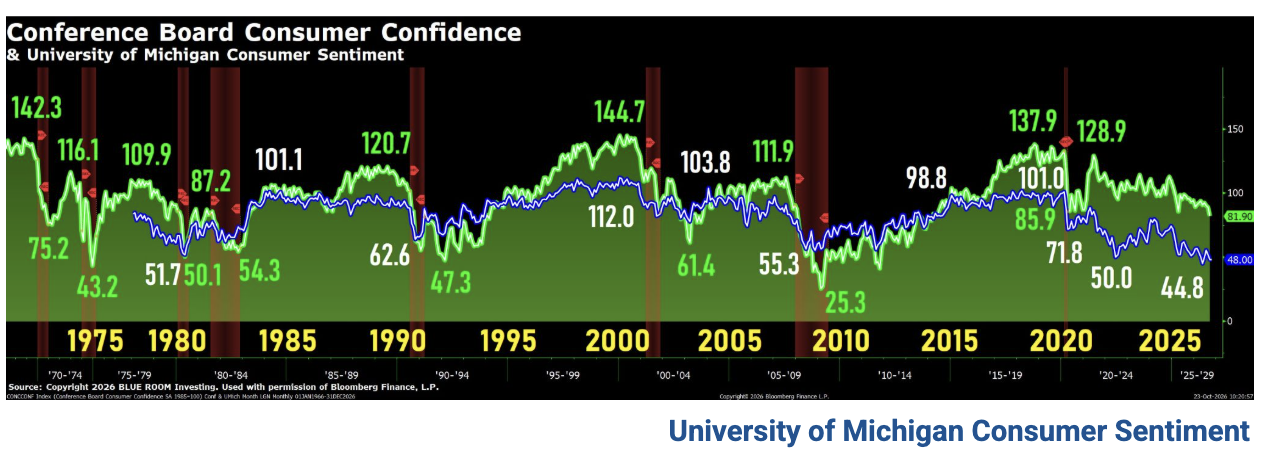
Consumer sentiment held steady this month at 48.0, registering a scant one-tenth of an index point below September.
Increases in sentiment among Republicans and Democrats were balanced by declines among independents.
While year-ahead business conditions improved about 14%, they stand 16% less than last October’s read.
This month’s decline in the Current Conditions subindex was driven entirely by buying conditions for durables, which plunged 18% on the basis of higher interest rates and rising concerns about the affordability of such purchases.
Purchasing power continues to dominate consumer views of the economy.
Sentiment is now 10% below a year ago and 15% less than February, just prior to the Iran conflict.
Year-ahead inflation expectations ticked up from 4.6% last month to 4.7% this month. The current reading substantially exceeds the 3.4% seen in February before the Iran conflict began, along with all 2024 readings. Long-run inflation expectations also stepped up from 3.4% in September to 3.5%, notably higher than their 2024 range of 2.8% to 3.2%. Inflation expectations over both time horizons increased for the second straight month to their highest readings since May.

David Rosa
Chief Executive Officer
Good afternoon, and thank you for joining us today. Q3 was a strong quarter for Intuitive, with broad-based adoption across our multiport, single-port and Ion platforms. In Q3, total procedures increased 15%, driven by 14% growth in da Vinci procedures and 31% growth in Ion procedures.
In the U.S., da Vinci procedure growth was 10%, and outside the U.S., da Vinci procedure growth was 20%. We exited the quarter with more than 13,200 da Vinci and Ion systems installed worldwide.
Over time, our customers have adopted, operationalized and standardized on the da Vinci ecosystem to provide their patients with improved care. That adoption has been driven by our commitment to innovation, robust training and clinical evidence, and it is apparent in how customers use da Vinci today. In the quarter, almost 7,000 customers in more than 70 countries performed da Vinci procedures at a rate of over 10,000 procedures per day.
On the clinical evidence front, more than 48,000 peer-reviewed publications have evaluated the effectiveness of da Vinci surgery, including the recent Benign COMPARE study, which Jaime Wong will discuss in more detail shortly.
As I described last quarter, we continue to see increasing segmentation across our customer base. Needs vary by procedure, site of care, geography and healthcare system. We have been investing to support this segmentation, and we have positioned Intuitive to serve current and future customers with both our existing technologies and those in development. Meeting those needs also requires that we evolve our commercial approach to tailor how we engage, price and provide solutions for customers in each segment.
In Q3, global customer demand across our da Vinci portfolio remained strong. Da Vinci system placements increased 28% worldwide, with da Vinci 5 and SP accounting for 65% of global placements. Installations of XiR and X more than doubled in the quarter.
Customers continue to adopt da Vinci 5 and its growing capabilities, with demand for both capacity expansion and system upgrades. We exited the quarter with more than 2,000 da Vinci 5 systems installed worldwide, used by over 18,000 surgeons since launch. We continue to see strong interest in XiR, both in the U.S. and internationally, where customers are leveraging its familiarity, capabilities and cost profile to build programs around a focused set of procedures.

Mark Zuckerberg
Chief Executive Officer
Hey, everyone. Thanks for joining today. This has been a busy and exciting few months.
Our family of apps is now used by 3.64 billion people each day, and we are seeing all-time highs in engagement on both Facebook and Instagram, driven by strong growth in video. Threads has now overtaken X in monthly actives and continues to grow quickly. WhatsApp is hitting all-time highs in messaging and is becoming an increasingly important platform for agents as well.
In the last few months, we have had several major milestones toward our goal of delivering personal superintelligence to everyone. We had one of our most successful launches ever with the Muse personal agent. We shipped Muse Wonder as our first frontier model, and we shipped several new glasses and gadgets with Muse integration, including our new audio glasses, which are coming soon.
We've been discussing our vision for personal superintelligence for more than a year now. We want to help every person have an extremely capable personal agent that understands their goals and can help them achieve them and improve their life in whatever ways they want, whether that's improving their relationships, helping them save time, save money, build a business, create new things, or anything else they can dream of. Muse is the product form of this vision.
So now we have the foundational technology in place to deliver this. There is still a lot of work ahead, but our initial position is very strong. In just a month and a half, more than 10 million people in the U.S. and Canada have set up Muse personal agents. Growth continues to be strong, and we have been number one in the App Store almost every day.
Engagement and retention are also off to a strong start. About 25% of people who have set up Muse use it on any given day. For our earliest adopters, the longer they use Muse, the better retention seems to get. To put this in perspective, this is more than twice the level that Threads started at, or where we believe other AI apps started at as well.
The most common use case for Muse is shopping. More than a quarter of people using Muse are engaging in this, with an average purchase size of over $200. Plaid told us that they hadn't seen activity like what they're seeing with their connector on any other service before. And in the first week, we had to work with Stripe to raise credit limits, since the volumes were above what any of us expected.
Beyond shopping, the most common connectors are for personal productivity, connecting Muse to your other services like email and calendar. This shows the importance of the Muse Secure VM that we've built to provide state-of-the-art privacy and security. We're looking forward to following up soon with the Muse Confidential VM, which will make it so that even Meta cannot see your content. We've also seen that Muse Wonder improves quality, engagement, and retention further, which suggests that as we continue to improve intelligence, Muse will perform better and better over time.
Now that Muse has clear product-market fit, we are entering a new, more operational phase that is focused on scaling it. The goals for this next phase play to many of Meta's strengths. We need to do three things: scale the product, grow revenue, and optimize compute costs.
We expect to grow Muse to serve billions of people. This is both our mission and our strategy. It's our mission in that we believe in putting the power of personal superintelligence in everyone's hands. We believe that is the path to ensuring a positive future for everyone, with individual empowerment as the source of prosperity and balance of power as the foundation for safety. On a values level, we believe that delivering this capability widely is the best thing we can be doing.

Justin Hotard
President & Chief Executive Officer
Thank you, David, and hello, everyone. Team Nokia continues to deliver on our commitments and execute on our strategy.
Growth is accelerating in the areas where we have chosen to focus and invest, and that growth is also beginning to translate into stronger operating leverage. In Q3, we grew net sales by 9% and expanded operating margin by 220 basis points to 11.7%. AI and cloud was again our largest growth engine, with earlier design wins converting into revenue in IP networks and continued strength in optical networks.
Mobile infrastructure grew in the quarter, as our focus remains on profitability and improving return on invested capital. Technology standards continues to execute its strategy in licensing. We are tracking to deliver above the midpoint of our full year outlook.
Before Marco takes you through the financial performance in more detail, I will give you an update on the progress that we are making against our strategic priorities.
In AI and cloud, net sales grew 123% year-over-year and represented 12% of total group net sales in the quarter. Order intake was strong again, up 118% year-over-year to EUR 1.5 billion. Demand from AI and cloud drove IP networks to grow 43% year-over-year, as previously announced design wins began to convert into revenue. Optical networks grew 18% and still contributed the majority of our revenue in this customer segment. However, IP networks is now playing a more prominent role.
In both businesses, we continue to see demand that exceeds supply. The market continues to develop, with demand accelerating across all segments, including scale-across, front-end networking and data center interconnect. Further, we also see demand extending into our telco customer base, as they invest to support demand from AI and cloud customers.
Optical networks and IP networks are now on track to grow somewhat above the 18% to 20% assumption we provided for the full year. For 2027, we now expect these businesses to grow between 25% and 30% on a combined basis, reflecting the strength of the underlying market and our position to capture that demand.
The build-out of AI infrastructure is driving demand across optical and IP networks. Demand for 800G coherent pluggables continues to accelerate, with shipment volumes increasing more than two-fold sequentially. We're securing orders from both hyperscalers and major telcos, and we now have design wins with 29 customers. We are also investing in our next-generation optical roadmap, developed in close collaboration with our hyperscale customers.
In line systems, an important growth area where we have historically had less share, we are making meaningful progress. During this quarter, we secured a significant win with a large hyperscaler. Our multi-rail technology, launched this past March, delivers 25% higher density than competing solutions in the market and has secured three design wins, with the first customer now receiving initial volumes.

Elon Musk — Founder and Chief Executive Officer
So we're in an inflection moment for SpaceX across launch connectivity and super intelligence. Starting with Starship, Flight 14 was a critical milestone. Starship made it to orbit for the first time and deployed operational Starlink V3 satellites. I think we have a recap video we're going to play.
For Flight 15, which we expect to happen next month, we're going to attempt to catch both the booster and the ship. This will be, if we succeed, will be the first time that an orbital launch vehicle has been fully recovered. This is a massive technology milestone. The only way that we can extend consciousness beyond Earth on a sustained basis is with a fully reusable orbital launch vehicle. So I think this is a profound technology milestone in the history of civilization consciousness.
So let's look at what a simulation of Flight 15 would look like if we succeed. If we don't succeed in Flight 15, we'll get there. So success is not guaranteed on these first flights, but I'd say it's more likely than not that this succeeds next flight. And if not, we have a steady stream of Starship flight attempts through the end of this year and then accelerating next year. So with that, the Flight 15 simulation.
We've also announced the development of the Louisiana Spaceport. So that's going to be an incredible asset to the country and to the world that will, I think, at some point probably have on the order of 20 or more launch towers and enable the transport of millions of tons per year to orbit and beyond. So that's really going to be a big deal. We expect Starship to fly weekly at some point in the first half of next year and then second half of next year twice weekly or maybe even more frequently than that by the end of next year.
The rate at which we launch Starship will increase dramatically as we solve the rapid and complete reusability. So we'll have complete reusability, then at first there will be a little bit of refurbishment that's needed between each flight and we'll iron out the need for any refurbishment such that you can immediately land the rocket and launch it again just like an airplane. As I said, this is a profound technology milestone that most people in the world don't realize how important it is, but it will be obvious in hindsight.




10% OF ALL BLUE ROOM REVENUES GO DIRECTLY TO FUND OUR NON PROFIT TOGETHERISM.
WE CAN ACCOMPLISH ANYTHING TOGETHER.
These materials do not purport to be all-inclusive or to contain all the information that a prospective investor may desire in considering an investment. These materials are intended merely for preliminary discussion only and may not be relied upon for making any investment decision. Any discussion or information contained in this presentation does not serve as a receipt of, or as a substitute for, personalized investment advice from Blueroom or your advisor.
This publication does not constitute an offer to sell or a solicitation to buy any securities in any fund, market sector, strategy or any other product. Investing is speculative and involves substantial risks (including, the risk of loss of the investor’s entire investment). Past performance is not indicative of future results, and there can be no assurance that the future performance of any specific investment, investment strategy, or product will be profitable.
For more information about us and our general disclosures contact us directly.