
Weekend Update #291
Thank you for your continued support and engagement. Each week, we're sharing what companies we're researching and the what, the who and the how that we think makes the companies interesting and unique. This roundup is brought to you weekly by a group of interns, creative minds, artists and investors who believe that through best in class investing along with the democratization of financial education we can do great things together. Enjoy, Explore and Share.

U.S. equities fell this week as escalation between the U.S. and Iran drove oil prices above $100 per barrel and pushed Treasury yields to multi-year highs. Major indices fell for 4 straight days prior to a Friday rebound, as last week’s stronger-than-expected jobs report and this week’s hotter-than-expected CPI report raised expectations for a hike in the federal funds rate at the September FOMC meeting. As of Friday’s close, the market-implied probability of a rate hike at the September 16 meeting rose to 88.1%, with markets pricing close to 4 rate hikes by September 2027. Geopolitics were a key focus of this week as the U.S. and Iran traded strikes on ships and reports indicated top White House advisers have warned the war could last through 2029. Escalation of a trade war between the U.S. and Canada also captured attention this week as retaliatory tariffs on $20 billion of U.S. goods and the U.S. indicated it would ban imports of Canadian motorbikes and other goods.
In economic data for the week, the CPI report for August was the key reading, coming in hotter-than-expected on the core CPI MoM growth of 0.3%. Headline CPI rose 0.4% MoM and 3.4% YoY while core CPI rose 2.4% YoY, all in line with economists' estimates. The acceleration seen in August was driven by a rebound in energy prices, with gasoline prices rising 3.9% MoM, as well as Telephone Services rising 5.4% MoM. Core CPI reached a new low since March 2021 at 2.446% YoY, showing inflation continues to trend lower, but shocks coming from supply disruptions in the Strait of Hormuz are adding persistence to inflation and threaten further price acceleration. The PPI report for August showed producer prices roughly in line with expectations but with a hot Final Demand reading of 5.4% YoY. Final Demand rose 0.4% MoM, and excluding food and energy, PPI rose 0.2% MoM and 4.6% YoY. Diesel prices jumped 24.1%, accounting for over a third of the August increase. The NFIB Small Business Optimism report for August fell below economist estimates as future expectations for business conditions among owners fell and reported sales fell. Initial Jobless Claims for the week ended September 5 were relatively in line with expectations at 206,000. The preliminary Consumer Sentiment report for September fell below expectations, driven by higher inflation expectations and plunging expectations for personal finances and business conditions.
In company-specific news, Oracle reported Q1 2027 results that beat estimates, with revenue rising 30% YoY and Cloud Infrastructure revenue rising 121% YoY. Adobe reported Q3 2026 results that beat quarterly expectations but missed analyst estimates for full-year revenue guidance. Apple shares gained as the company debuted its iPhone 18 line as well as the new foldable iPhone Duo this week at its September hardware event. Meta debuted a new personal AI agent called Muse which sent shares higher this week.
Friday’s Close (Weekly Performance)
S&P 500 7,656.98 (-0.80%)
Nasdaq 26,333.04 (-0.66%)
Dow Jones 52,573.29 (-1.57%)
Thank you Blue Room Senior Analyst JARED FENLEY
Wahid Nawabi
Chairman, President, & Chief Executive Officer
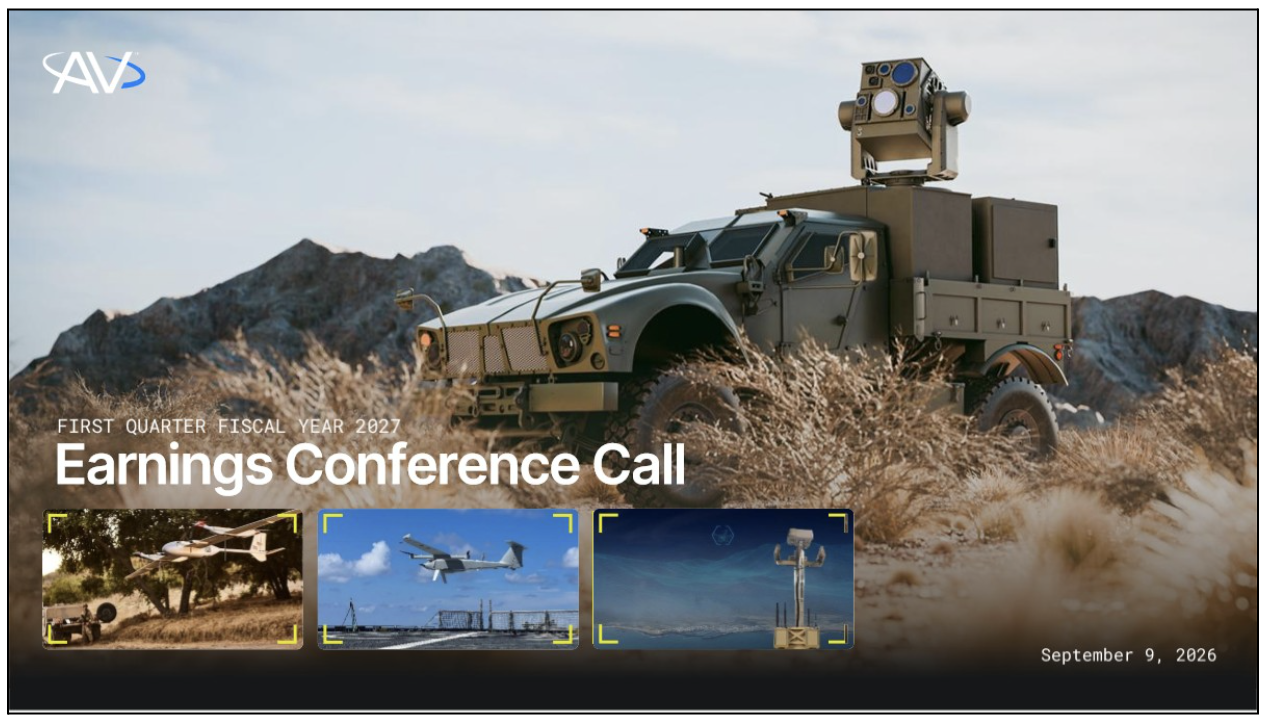
Thank you, Denise. Welcome, everyone, to our first quarter fiscal year 2027 earnings conference call. I will begin today's call by summarizing our quarterly performance, followed by Sean, who will review our financial results in greater detail. After this, Sean, Denise, and I will take your questions.
I'm pleased to report excellent first-quarter results across several key financial performance metrics that meet or exceeded our expectations. AV reported first quarter revenues of $480 million with record-setting funded backlog of $1.5 billion, as well as adjusted EBITDA of nearly $46 million and bookings of $683 million. These results reflect our focus on capturing key growth opportunities and our ability to execute with excellence. Building on our success from fiscal year 2026, we believe our first quarter results have positioned us well to deliver an even greater and stronger fiscal year 2027.
Before discussing the details of our strong results, let me first highlight some key achievements from the first quarter. First, we won several key contracts on franchise programs during the quarter that contributed to $683 million in bookings. These wins add to a strong bookings pipeline for both this fiscal year and beyond. Second, our funded backlog grew to a record $1.5 billion, which is 37% higher than the same period last year. Third, we achieved record first quarter revenue of $480 million. And fourth, we continue to advance our manufacturing capacity expansion plans across several of our platforms and products to support our strong growth over the next several years.
With a strong quarter behind us and positive momentum carrying us into the second quarter, we are reaffirming our fiscal year 2027 revenue guidance of between $2.125 billion and $2.225 billion, and adjusted EBITDA guidance for fiscal year 2027 of between $305 million and $325 million.
Both of our business segments are progressing well toward their fiscal year 2027 growth goals, supported by key domestic and international program wins and increased backlog and revenue contributions. During the first quarter, our Autonomous Systems segment contributed $346 million, or 72% of the total company revenue, while our Space, Cyber and Directed Energy segment contributed $134.5 million in revenue, or 28% of the total company revenue, consistent with our plans for the quarter. Both segments contributed to the 25% increase in funded backlog from the prior quarter, due to very strong order flow and several sole-source wins.
Our total funded backlog now stands at $1.5 billion. Strong contract wins across multiple programs in both segments, particularly in counter-UAS, positions us for a record fiscal year 2027 and supports our progress towards long-term growth goals.
I would like to now walk you through some significant achievements since our last earnings call in each of our four main product areas, which are Multi-Mission ISR, Precision Strike, counter-UAS, and Space and Advanced Technologies.

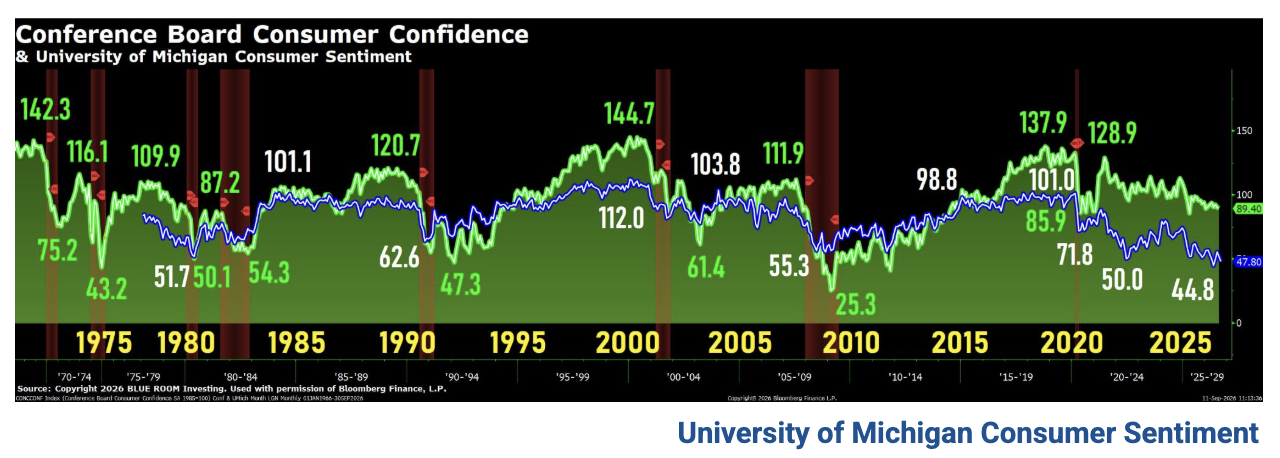
Consumer sentiment receded less than 4 index points to 47.8 for the second consecutive month of decreases.
Democrats and Republicans alike posted sizable declines, while independents were little changed from August.
Year-ahead expectations for both personal finances and business conditions plunged. With a resurgence in fuel prices and trade tensions, consumers anticipate greater pressures on their pocketbooks to come.
Five-year expected business conditions remained stable at readings well below their historical average, suggesting that consumers believe that emerging risks this month may not have further worsened the long-run outlook.
Overall, sentiment is now 16% below February, prior to the start of the Iran conflict, and 13% lower than a year ago.
Year-ahead inflation expectations jumped from 4.0% last month to 4.6% this month, the highest reading since June. The current reading substantially exceeds the 3.4% seen in February before the Iran conflict began, along with all 2024 readings.
Long-run inflation expectations ticked up to 3.4%, ending three consecutive months at 3.3%. These expectations remain higher than their 2024 range of 2.8% to 3.2%.
Consumers perceive rising pressures on their cost of living both now as well as the future. About 56% of consumers cited high prices as a negative factor for their personal finances, up from 53% last month and 44% a year ago. After declining for two straight months, spontaneous references to gasoline increased this month at 29% of consumers amid rising fuel prices. Unsolicited comments about tariffs rose for the second month in a row, from 24% in July to 36% in September. Looking ahead, consumers mentioning gasoline reported higher short-run inflation expectations than those who did not, with similar patterns for tariff mentions. Differences are limited to the one-year time horizon; long-run inflation expectations were comparably elevated whether or not consumers mentioned tariffs or gasoline.




10% OF ALL BLUE ROOM REVENUES GO DIRECTLY TO FUND OUR NON PROFIT TOGETHERISM.
WE CAN ACCOMPLISH ANYTHING TOGETHER.
These materials do not purport to be all-inclusive or to contain all the information that a prospective investor may desire in considering an investment. These materials are intended merely for preliminary discussion only and may not be relied upon for making any investment decision. Any discussion or information contained in this presentation does not serve as a receipt of, or as a substitute for, personalized investment advice from Blueroom or your advisor.
This publication does not constitute an offer to sell or a solicitation to buy any securities in any fund, market sector, strategy or any other product. Investing is speculative and involves substantial risks (including, the risk of loss of the investor’s entire investment). Past performance is not indicative of future results, and there can be no assurance that the future performance of any specific investment, investment strategy, or product will be profitable.
For more information about us and our general disclosures contact us directly.