
Weekend Update #278

Thank you for your continued support and engagement. Each week, we're sharing what companies we're researching and the what, the who and the how that we think makes the companies interesting and unique. This roundup is brought to you weekly by a group of interns, creative minds, artists and investors who believe that through best in class investing along with the democratization of financial education we can do great things together. Enjoy, Explore and Share.

Wall Street capped a tumultuous but ultimately resilient week, with the S&P 500 on track for its longest streak of weekly gains since December 2023. Equity markets swung violently throughout the period, whipsawed by conflicting signals from the US-Iran standoff — the dominant macro narrative driving both risk appetite and commodity prices. The Dow Jones Industrial Average set a fresh record close on Thursday, gaining 276 points to 50,285.66, while the S&P 500 and Nasdaq logged modest gains of 0.17% and 0.09%, respectively, that session. Friday's session extended the winning streak, with all three major indices finishing higher, led by the Dow's near 300-point advance amid renewed ceasefire optimism. The week's intraday volatility was pronounced — stocks slumped sharply mid-week as oil spiked and Treasury yields climbed on reports that Iran intended to retain its enriched uranium stockpile, before reversing course as diplomatic progress re-emerged. The prevailing market mood was viewed as a "hope-driven" rally, with investors choosing to look past near-term macro headwinds and price in a constructive geopolitical resolution.
The macro backdrop remained challenging, with key data reinforcing a stagflationary narrative. US consumer sentiment fell in May to a record low, weighed down by the economic toll of the Iran conflict and persistent cost-of-living pressures; long-run inflation expectations jumped to 3.9% annualized from 3.5% in April, with 57% of consumers citing high prices as a drag on personal finances. In the bond market, 30-year Treasury yields hovered near 5.13%, with some strategists warning of a potential breach of 5.5%, as investors demanded higher compensation for inflation risk and fiscal uncertainty. The average 30-year mortgage rate exceeded 6.5%, deepening affordability strains in the housing market, though homebuilder sentiment edged up 3 points to 37 in May — remaining well below the threshold of 50 that signals healthy conditions. Federal Reserve Governor Christopher Waller struck a notably hawkish tone, warning that the next rate move is just as likely to be a hike as a cut, and stating that inflation is "not headed in the right direction." Waller acknowledged the labor market has stabilized without booming, and affirmed that current policy remains restrictive — but the door to further tightening is clearly open.
NVIDIA delivered another blowout quarter, reporting Q1 FY2027 revenue of $81.6 billion — up 85% year over year — driven almost entirely by insatiable AI and data center demand, with management guiding Q2 revenue to approximately $91 billion and announcing an $80 billion buyback authorization alongside a sharp dividend increase to $0.25 per share quarterly. The company's new segment reporting structure — splitting the business into Hyperscale and ACIE (AI Clouds, Industrial & Enterprise) — is designed to demonstrate that AI infrastructure spending is broadening well beyond the hyperscalers. In financial services, Standard Chartered announced plans to cut nearly 8,000 support roles over four years as it scales AI across corporate functions, targeting a 20% productivity-driven income-per-employee improvement by 2028. Anthropic, maker of the Claude AI assistant, is expected to close a funding round in excess of $30 billion at a valuation above $900 billion as soon as next week, co-led by Sequoia Capital, Dragoneer, Altimeter, and Greenoaks, each committing roughly $2 billion. On the regulatory front, the SEC is preparing to release an innovation exemption for tokenized stocks, a framework that would permit trading of crypto-linked equity tokens without the backing or consent of the underlying public companies — a move that has drawn significant investor protection concerns.
The week ahead will be defined by the trajectory of US-Iran negotiations, with markets hypersensitive to any signal regarding the Strait of Hormuz, Iran's uranium stockpile, and the proposed oil-sanctions waiver. Gulf Arab states — the UAE, Saudi Arabia, and Qatar — have taken an increasingly active role in urging restraint from Washington, and Pakistan continues to serve as a mediating conduit; any breakdown or breakthrough in talks could move oil and equities sharply. On the data front, investors will watch closely for any fresh inflation prints and Fed communications, given Waller's hawkish signals this week and the elevated long-end yield environment. Housing data will also be in focus given the ongoing affordability squeeze. NVIDIA's guidance will continue to set the tone for the AI trade, and further commentary from mega-cap tech on capital expenditure plans and AI monetization timelines will be scrutinized. The Anthropic funding round closing, if confirmed, would serve as another sentiment marker for private AI valuations. Traders will enter the new week with one eye on geopolitics and the other on any indication that the Fed's next move may come sooner — or be larger — than the market currently expects.
Friday's Close
(Weekly Performance)
Index Price Weekly %
S&P 500 7,473.47 +0.88%
Nasdaq 26,343.97 +0.45%
Dow Jones 50,579.70 +2.13%
Thank you Blue Room Senior Analyst NICK PEART.

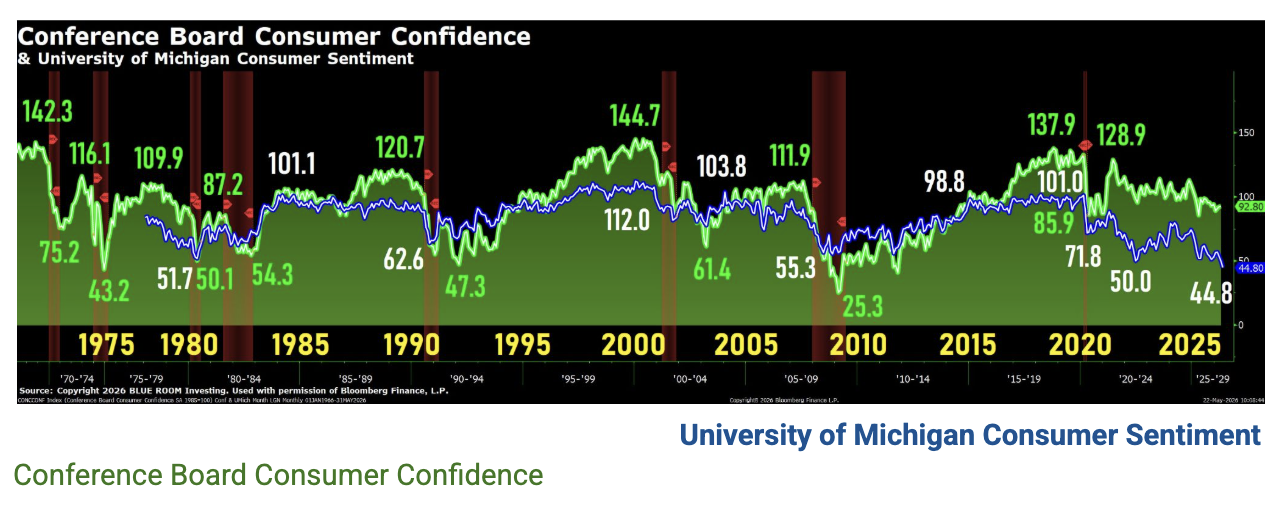
Consumer sentiment fell for the third straight month to 44.8 as supply disruptions in the Strait of Hormuz continue to boost gasoline prices. Sentiment is now just below the previous historical trough seen in June 2022.
The cost of living continues to be a first-order concern, with 57% of consumers spontaneously mentioning that high prices were eroding their personal finances, up from 50% last month.
Lower-income consumers and those without college degrees posted particularly strong sentiment declines; these groups are more sensitive to increases in the cost of gas and other essentials.
Independents and Republicans saw decreases in sentiment, with both groups reaching their lowest readings of the current presidential administration. Meanwhile, sentiment of Democrats was little changed from last month.
Critically, consumers appear worried that inflation will increase and proliferate beyond fuel prices, even in the long run.




10% OF ALL BLUE ROOM REVENUES GO DIRECTLY TO FUND OUR NON PROFIT TOGETHERISM.
WE CAN ACCOMPLISH ANYTHING TOGETHER.
These materials do not purport to be all-inclusive or to contain all the information that a prospective investor may desire in considering an investment. These materials are intended merely for preliminary discussion only and may not be relied upon for making any investment decision. Any discussion or information contained in this presentation does not serve as a receipt of, or as a substitute for, personalized investment advice from Blueroom or your advisor.
This publication does not constitute an offer to sell or a solicitation to buy any securities in any fund, market sector, strategy or any other product. Investing is speculative and involves substantial risks (including, the risk of loss of the investor’s entire investment). Past performance is not indicative of future results, and there can be no assurance that the future performance of any specific investment, investment strategy, or product will be profitable.
For more information about us and our general disclosures contact us directly.