

Thank you for your continued support and engagement. Each week, we're sharing what companies we're researching and the what, the who and the how that we think makes the companies interesting and unique. This roundup is brought to you weekly by a group of interns, creative minds, artists and investors who believe that through best in class investing along with the democratization of financial education we can do great things together. Enjoy, Explore and Share.

Major equity indices ended the week slightly lower as geopolitical tensions, key economic data releases, and the beginning of earnings season provided a wave of information for the market to digest. Marking a new market rotation, the Russell 2000 has now outperformed the S&P 500 for 11 consecutive days, the longest winning streak since 2008. This puts the Russell’s year-to-date performance at +7.89% compared to the S&P 500’s +1.38% gain. Equity gains have broadened in January with investor focus on upcoming earnings results to support AI-related tech valuations.
The week began with high tensions over potential U.S. military intervention in Iran, with President Trump promising aid for protestors and imposing 25% tariffs on countries doing business with Iran. As Tehran backed off from using the death penalty against protestors, geopolitical tensions eased but were still impacted by the president’s statements around acquiring Greenland for national security purposes. Meanwhile, President Trump signed an agreement with Taiwan to lower tariffs in exchange for a $250 billion investment commitment for semiconductor technology in the U.S. The Supreme Court decision on the legality of the president’s global tariffs has also been a key issue, but the court did not issue a decision this week. The next round of decisions is slated for January 20th. Following last week’s grand jury subpoenas from the Justice Department on Federal Reserve Chair Jerome Powell, President Trump this week hinted that he may not appoint the front-runner, Kevin Hasset. Prediction market odds now favor Kevin Warsh to be appointed Fed Chair in the coming weeks.
In economic data for the week, NFIB’s December Small Business Optimism surpassed consensus estimates, with improving economic and earnings expectations supporting the index. The December CPI report showed cooler-than-expected inflation, with consumer prices rising 0.3% MoM and 2.7% YoY due to lower growth in the cost of shelter and energy. Meanwhile, the November PPI report showed producer prices rising more than expected, up 0.2% MoM and 3.0% YoY, due to a 10.5% MoM increase in gasoline inputs. November Retail Sales growth beat estimates, rising 0.6% MoM and 0.4% excluding automobiles and gas, showing strong consumer activity around Black Friday/Cyber Monday sales. Initial Jobless Claims for the week ended January 10th were 198,000 compared to the 215,000 consensus estimate, with the 4-week moving average falling to the lowest since January 2024.
Banks kicked off this earnings season with mixed results. Goldman Sachs and Morgan Stanley surprised to the upside while J.P. Morgan fell short on expectations for its investment banking business. Citigroup also gained while Wells Fargo and Bank of America shares were under pressure. President Trump’s proposal to cap credit card interest rates at 10% drew criticism from banks and added a layer of uncertainty to the environment this week. The proposal fits squarely within the president’s promise to lower costs and grow wealth for American consumers, a central message leading up to the midterm elections. Banks have argued that a 10% rate cap could slow GDP growth as more stringent lending standards are applied to consumers and fewer Americans are able to access credit.
Friday’s Close (Weekly Performance)
S&P 500 6,940.00 (-0.38%)
Nasdaq 23,515.39 (-0.66%)
Dow Jones 49,359.33 (-0.29%)
Thank you Blue Room Senior Analyst JARED FENLEY
The Senate Banking Committee released a bipartisan “manager’s amendment” late Monday ahead of a markup originally scheduled for Thursday. While that markup has since been postponed, the revised language sheds light on how lawmakers are attempting to balance innovation in digital assets with long-standing concerns from the banking sector about deposit flight and consumer protection.
Link Senate Market Structure Draft
Key Provisions of the CLARITY Act
Ancillary Asset Reclassification
The bill introduces the term "ancillary asset" to address a major industry grievance: the SEC's tendency to classify all tokens as securities. An ancillary asset is defined as a network token whose value depends on the efforts of an originator. This creates a pathway for tokens to be treated as non-securities for secondary market trading, removing the threat of SEC enforcement for exchanges listing these tokens, provided the originator meets specific disclosure and common control requirements.
Regulation Crypto Framework
Section 103 mandates the creation of "Regulation Crypto," a new framework for token sales that allows originators to sell up to $50 million in ancillary assets per year, with a $200 million lifetime cap, without traditional securities registration. This provides a safe harbor for startups to raise funds via token sales while maintaining public transparency through semiannual SEC filings.
DeFi Developer Protections
The draft specifically carves out protections for software developers and decentralized protocols by explicitly stating that developers are not subject to securities laws solely for writing, publishing, or operating code for a distributed ledger system. This prevents the SEC from treating code itself as a broker-dealer or exchange, protects the First Amendment rights of developers, and encourages the launch of permissionless protocols in the United States.
Banking System Integration
Title IV brings crypto into the traditional financial fold by expressly permitting financial holding companies and national banks to provide custodial services, node operation, and staking for digital assets. This ends Operation Choke Point-style restrictions, allowing banks to compete with crypto-native platforms, and prohibits regulators from forcing banks to treat custodied digital assets as liabilities on their balance sheets, effectively negating SEC Staff Accounting Bulletin 121.

Company Participants
Kimberly Powell – NVIDIA Vice President of Healthcare
Harlan Sur, JPMorgan Chase
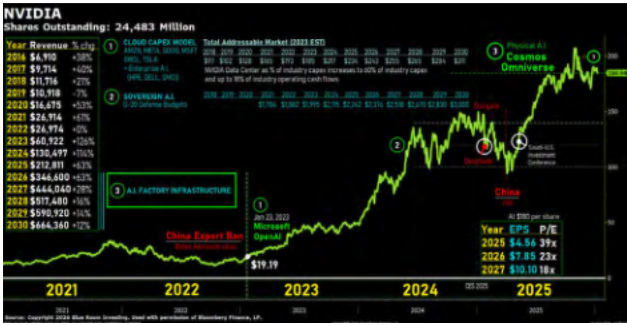
Good afternoon, and welcome to JPMorgan's 44th Annual Healthcare Conference in San Francisco. My name is Harlan Sur. I am the United States semiconductor analyst for the firm. For the seventh year, we have the team from NVIDIA presenting. As all of you know, NVIDIA is the leader in accelerated computing in AI semiconductor, software, systems, enabling the development and deployment of the world's AI foundational models, like large language models, enabling next–generation reasoning and agentic–based frameworks and now moving the industry adoption curve to physical AI and driving compute innovation for cloud, hyperscalers as well as large vertical markets like health care and life sciences.
Here with us today from NVIDIA is Kimberly Powell, Vice President and General Manager of Healthcare at NVIDIA. She is responsible for the company's worldwide health care business, including hardware and software platforms for accelerated compute and AI that power the ecosystems of imaging, genomics, life sciences, drug discovery and health care analytics. Kimberly, great to have you back again. Let me turn it over to you.
Kimberly Powell
NVIDIA, Vice President of Healthcare
Thank you, Harlan. Good evening, everyone. This is the first time I have been between you and cocktails, but I am going to make sure it is as entertaining as humanly possible. In just a few words, this is an absolute once–in–a–generation platform shift for the health care industry.
And I am so honored to be invited back for the seventh year. We are in our 17th year of working on health care at NVIDIA. And I thank the conference very much for this opportunity, and all of the partners that we work with day in and day out, which I hope I am going to be able to share what the future is going to look like.
2025 was an absolute breakout year for agentic AI. Many things came together in just the last 12 months. You have heard the words reasoning, and AI models that can reason. You have heard the words tool use. Software that can actually use tools on behalf of the human user. You have heard the word retrieval being able to attach language models with trusted information and trusted knowledge. Agentic AI is here alive and being deployed faster in health care than any other industry.


President Trump
Beautiful. Wow. It's beautiful. It's the first renderings of what we are doing.
I want to wish everybody a Big Hello and Merry Christmas and welcome to Mar–a–Lago for this exciting announcement of the new Golden Fleet. We are calling it the Golden Fleet that we are building for the United States Navy. As you know, we are desperately in need of ships. Our ships, some of them have gotten old and tired and obsolete and we are going to go the exact opposite direction.
We are delighted to be joined by Secretary of War Pete Hegseth who is doing a fantastic job and Secretary of the Navy John Phelan. Secretary of State Marco Rubio is here. He gave a great few words toward the end of last week. He spoke for a couple of hours on what a good job we are doing, which is true.
As Commander-in-Chief, it is my great honor to announce that I have approved a plan for the Navy to begin the construction of two brand new, very large, the largest we have ever built: battleships.
You used to build the Iowa, the Missouri, the Wisconsin, the Alabama, and many others. We had big battleships. These are bigger, but they will have 100x the force, the power, and there has never been anything like these ships.
These have been under design consideration for a long time. And it started with my first term because I said, "Why aren't we doing battleships like we used to?"
And these are the best in the world. They will be the fastest, the biggest, and by far 100x more powerful than any battleship ever built. So if you look at the Iowa, the Missouri, Wisconsin, Alabama, and others, but they were similar in size, some a little bit bigger than the others, but if you take the biggest one, it is 100x more powerful. They are longer by a little bit, and they are bigger. They are bigger ships, but they hold much more. They use the word lethality.
Battleships are the largest, sturdiest, and most heavily armed vessel built specifically for naval combat. While America has built many new warships over the years, they have tended to be smaller, much smaller and not conducive to where we are and where we are going and peace through strength. We have been building aircraft carriers. We are going to be upping that also. We are going to be going to a superior aircraft carrier. We have the Gerald R. Ford class. We are going to be upping that to a different class of aircraft carrier. We have not built a battleship since 1994.
These cutting edge vessels will be some of the most lethal surface warfare ships. They will be actually the most ever built, other than our submarines. We have submarines which will have in many ways even more lethality and we have many of them under construction.
Each one of these will be the largest battleship in the history of our country. The largest battleship in the history of the world ever built. And again, it is 100x more powerful than the previous Iowa class, it is called. Those are the big ones that you would see on a show called Victory at Sea. I do not know if anyone has seen Victory at Sea, but it was a classic. They will help maintain American military supremacy, revive the American ship building industry, and inspire fear in America's enemies all over the world.
We want respect. We are going to have it. We already have it. More respected now than we ever were. A year and a half ago, they laughed at us. Now they respect us again at levels that they have never respected us.

Press Release
January 12, 2026 at 5:01 AM MT
Precision BioSciences, Inc., a clinical stage gene editing company utilizing its novel proprietary ARCUS platform to develop in vivo gene editing therapies for high unmet need diseases, today provided a business update and announced strategic priorities for 2026, highlighting recent progress for its two lead programs, upcoming clinical milestones, and a strong financial position supporting execution through key value-inflection points.
“We continue to make steady, disciplined progress across our clinical-stage programs,”
said Michael Amoroso, Chief Executive Officer of Precision BioSciences.
“With multiple dosing cohorts underway in our global Phase 1/2a ELIMINATE–B trial, our first-in-class gene editing approach for DMD entering the clinic in early 2026, and cash runway through 2028, we expect continued operational excellence this year with clear clinical and regulatory milestones for these potentially transformative therapies.”
PBGENE–HBV: Dose Finding Phase 1/2a ELIMINATE-B Trial in Chronic Hepatitis B
NCT06680232 (link to ClinicalTrials.gov)
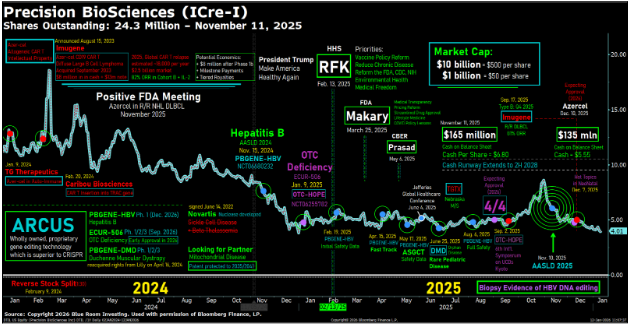
PBGENE–HBV is uniquely designed to potentially achieve a complete cure of Hepatitis B by eliminating cccDNA, preventing the chance of viral relapse, and inactivating integrated HBV DNA. The data reported at AASLD in November 2025 as of the October 31st cutoff date showed clear positive evidence of dose-dependent effects and antiviral activity in all patients. The data also included paired biopsies providing the first molecular evidence of successful viral DNA gene editing in patients with hepatitis B.
The safety data showed PBGENE–HBV to have no dose-limiting toxicities at doses up to 0.8 mg/kg (Cohort 3) following the first administration. Adverse events across 22 total administered doses in 9 patients in the first 3 dose cohorts (0.2 mg/kg, 0.4 mg/kg, and 0.8 mg/kg) were predictable, manageable, and transient, including hypotension in the higher dose cohorts. Transaminase elevations were transient without elevations in bilirubin and resolved without intervention, and platelet fluctuations were transient and asymptomatic.

Schrödinger Provides Update on Progress Across the Business and Outlines 2026 Strategic Priorities
January 12, 2026
Schrödinger, Inc. provided an update on its progress across the business in 2025 and announced its strategic priorities for 2026. The company is continuing to focus on advancing its physics+AI computational platform and serving as a global leader in computational molecular discovery.
“In 2025, we witnessed the continued impact of scaling ‘physics+AI’ to solve the challenges of data scarcity and to accelerate the discovery of differentiated molecules. We are entering 2026 with a clear mandate: to further strengthen our position as the essential design engine for the industry,” stated Ramy Farid, Ph.D., chief executive officer at Schrödinger.
“Our priorities for 2026 are focused on scaling our impact, maintaining scientific leadership, expanding the reach of our platform, advancing our collaborative portfolio of drug discovery programs, and securing development partners for our clinical programs. We are entering 2026 with strong momentum, highlighted by new strategic agreements with Eli Lilly and Manas AI.”
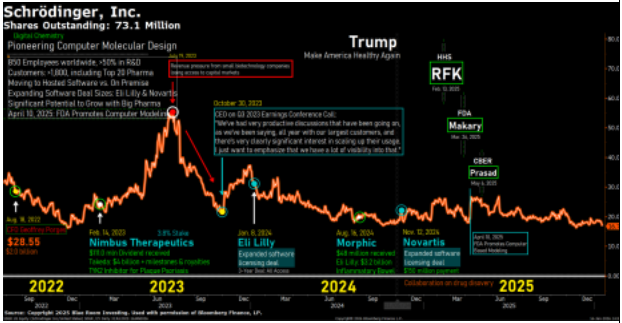
Last week, Schrödinger announced that the Lilly TuneLab™ platform will be integrated into LiveDesign, Schrödinger’s widely used enterprise informatics solution. This allows users to combine Lilly’s federated learning models with Schrödinger’s physics-based simulations, solving the data scarcity problem that often hinders AI–driven discovery.
Today Manas AI announced that it entered into a strategic agreement with Schrödinger that grants Manas AI access to Schrödinger’s computational platform at an ultra–large scale and integrates Schrödinger’s physics–based modeling solutions with Manas AI’s algorithms to improve predictive accuracy and speed.

Taiwan Semiconductor Manufacturing Company Limited
Q4 2025 Earnings Call
January 15, 2026
1:00 AM EST
Company Participants
Jeff Su – Director of Investor Relations
Jen–Chau Huang – Senior VP of Finance & CFO
C.C. Wei – Chairman & CEO
Conference Call Participants
Gokul Hariharan – JPMorgan Chase
Chia Yi Chen – Citigroup
Charlie Chan – Morgan Stanley
Yu Jang Lai – Macquarie Research
Brett Simpson – Arete Research
Sunny Lin – UBS
Zheng Lu – Goldman Sachs
Mr. Wendall Huang, Senior VP of Finance & CFO
Thank you for joining us today. My presentation will start with financial highlights for the fourth quarter of 2025 and a recap of the full year 2025. After that, I will provide the guidance for the first quarter of 2026. Fourth quarter revenue increased 5.7% sequentially in NT, supported by strong demand for our leading–edge process technologies. In U.S. dollar terms, revenue increased 1.9% sequentially to TWD 33.7 billion, slightly ahead of our fourth quarter guidance.
Gross margin increased by 2.8 percentage points sequentially to 62.3%, primarily due to cost improvement efforts, favorable foreign exchange rate and high capacity utilization rate. The operating expenses accounted for 8.4% of net revenue compared to 8.9% in the third quarter of 2025 due to operating leverage. Thus, operating margin increased sequentially by 3.4 percentage points to 54%. Overall, our fourth quarter EPS was TWD 19.5 and ROE was 38.8%.
Now let's move on to revenue by technology. 3–nanometer process technology contributed 28% of wafer revenue in the fourth quarter, while 5–nanometer and 7–nanometer accounted for 35% and 14%, respectively.
Advanced technologies, defined as 7–nanometer and below, accounted for 77% of wafer revenue. On a full year basis, 3–nanometer revenue contribution came in at 24% of 2025 wafer revenue, 5-nanometer, 36% and 7–nanometer, 14%. Advanced technologies accounted for 74% of total wafer revenue, up from 69% in 2024.
Moving on to revenue contribution by platform. High Performance Computing increased 4% quarter–over–quarter to account for 55% of our fourth quarter revenue. Smartphones increased 11% to account for 32%. IoT increased 3% to account for 5%. Automotive decreased 1% to account for 5%, while DCE decreased 22% to account for 1%.

TG Therapeutics, Inc.
44th Annual J.P. Morgan Healthcare Conference
January 13, 2026
4:30 PM EST
Company Participants
Michael Weiss – Chairman, CEO & President
Moderator
Lut Ming Cheng – JPMorgan Chase & Co, Research Division
Lut Ming Cheng
Thank you for joining us at the 44th JPMorgan Healthcare Conference. I am Brian Cheng. I am one of the senior biotech analysts here at the firm. On stage, we have Mike Weiss, who is the CEO of TG Therapeutics. I will now pass the microphone to Mr. Weiss for a short presentation, followed by a live audience Q&A. Mike, the stage is yours.
Michael Weiss, Chairman, CEO & President
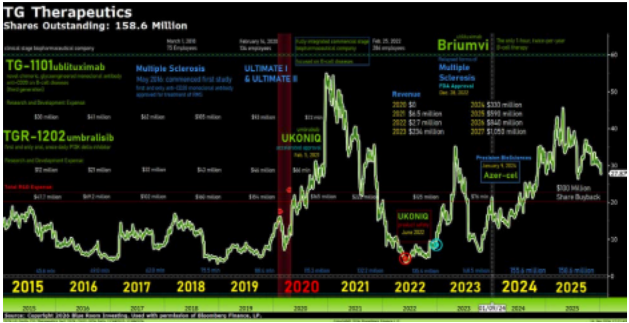
For those of you who may not be that familiar with TG Therapeutics, we were founded in 2012 with a focus on B–cell–mediated diseases. These can range from autoimmune diseases to neuroinflammatory as well as cancer. But today, we are focused primarily on Multiple Sclerosis. We have one approved drug, BRIUMVI for multiple sclerosis, which is approaching blockbuster status. We have 2 pivotal trials ongoing to expand the utilization and total addressable market for BRIUMVI, and we have 3 programs under development.
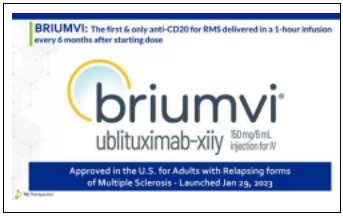
BRIUMVI is our approved anti–CD20 monoclonal antibody. It was approved in late December 2022 and launched in January 2023, so a little under 3 years ago. And not only is BRIUMVI available in the United States, it is available now globally. Our partners at Neuraxpharm are commercializing it across Europe and the rest of the world. It's now available in 16 countries. And to date, over 20,000 patients have been prescribed BRIUMVI, most of those in the United States.




10% OF ALL BLUE ROOM REVENUES GO DIRECTLY TO FUND OUR NON PROFIT TOGETHERISM.
WE CAN ACCOMPLISH ANYTHING TOGETHER.
These materials do not purport to be all-inclusive or to contain all the information that a prospective investor may desire in considering an investment. These materials are intended merely for preliminary discussion only and may not be relied upon for making any investment decision. Any discussion or information contained in this presentation does not serve as a receipt of, or as a substitute for, personalized investment advice from Blueroom or your advisor.
This publication does not constitute an offer to sell or a solicitation to buy any securities in any fund, market sector, strategy or any other product. Investing is speculative and involves substantial risks (including, the risk of loss of the investor’s entire investment). Past performance is not indicative of future results, and there can be no assurance that the future performance of any specific investment, investment strategy, or product will be profitable.
For more information about us and our general disclosures contact us directly.